A scooter is going towards east at 10 ms–¹ turns right through an angle of 90°. If the speed of the scooter remains unchanged in taking this turn, the change in the velocity of the scooter is :
1. 20.0 ms–¹ in south–western direction
2. zero
3. 10.0 ms–¹ in southern direction
4. 14.14 ms–¹ in south–western direction
View Answer
Change in a vector when it is rotated by an angle θ is
\[ \Delta V = 2V sin \left( \frac{\theta}{2} \right) \]
\[ \Delta V = 2\times 10 sin \left( \frac{90^{0}}{2} \right)= 20/\sqrt{2}= 10\sqrt{2}= 14.4 m/s \]
Figure shows position versus time graph of two rabbits running opposite to each other between two trees. Which of the following statements are true.
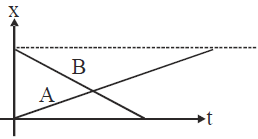
1. Rabbit A has greater magnitude of average velocity.
2. Rabbit B has greater magnitude of average velocity.
3. Both the Rabbits have same displacement.
4. Both the Rabbits have same constant speed.
View Answer
Distance is equal for both A and B. B is taking lesser time to complete so its speed is higher.
A body moves from A to B with a constant speed of \(20\text{ ms}^{-1}\) and returns from B to A with a constant speed of \(40\text{ ms}^{-1}\). The average speed of the body for the whole journey is
1. \((80/3)\text{ ms}^{-1}\)
2. \(30\text{ ms}^{-1}\)
3. \(24\text{ ms}^{-1}\)
4. \(32\text{ ms}^{-1}\)
View Answer
For equal distances covered in two halves of a journey, average speed is \(v_{\text{avg}} = \frac{2v_1v_2}{v_1+v_2}\). Here, \(v_{\text{avg}} = \frac{2 \times 20 \times 40}{20+40} = \frac{80}{3}\text{ ms}^{-1}\).
A vehicle travels half of the total distance with speed 2 m/s and the other half with speed 5 m/s, then its average speed is
1. \[\frac{7}{2}\text{ m/s}\]
2. \[\frac{20}{7}\text{ m/s}\]
3. \[\frac{14}{3}\text{ m/s}\]
4. \[\frac{7}{20}\text{ m/s}\]
View Answer
Formula: For equal halves of distance, the average speed is the harmonic mean: \(v_{av} = \frac{2v_1v_2}{v_1+v_2}\). Putting values, \(v_{av} = \frac{2 \times 2 \times 5}{2+5} = \frac{20}{7}\text{ m/s}\).
Assertion (A): The speedometer of an automobile measures the average speed of the automobile.
Reason (R): Average velocity is equal to total distance divided by total time taken.
1. (1) Both (A) \& (R) are true and the (R) is the correct explanation of the (A)
2. (2) Both (A) \& (R) are true but the (R) is not the correct explanation of the (A)
3. (3) (A) is true but (R) is false
4. (4) Both (A) and (R) are false
View Answer
A speedometer measures instantaneous speed, not average speed. Average velocity is defined as total displacement divided by total time, while average speed is total distance divided by total time. Both assertion (A) and reason (R) are incorrect.
Assertion (A): The average speed of an object may be equal to arithmetic mean of individual speeds.
Reason (R): The average speed is equal to total distance travelled per total time taken.
1. (1) Both (A) \& (R) are true and the (R) is the correct explanation of the (A)
2. (2) Both (A) \& (R) are true but the (R) is not the correct explanation of the (A)
3. (3) (A) is true but (R) is false
4. (4) Both (A) and (R) are false
View Answer
Average speed is defined as total distance divided by total time, making reason (R) true.
Assertion (A) is also true, as average speed can be equal to the arithmetic mean of individual speeds if the time intervals for those speeds are equal. However, reason (R) only defines average speed, it does not explain the condition under which it equals the arithmetic mean.
Assertion (A): \(|\Delta v| / \Delta t\) and \(\Delta |v| / \Delta t\) are same if particle is moving in one dimension.
Reason (R): In one dimensional motion there is no component of acceleration perpendicular to velocity.
1. Both (A) & (R) are true and the (R) is the correct explanation of the (A)
2. Both (A) & (R) are true but the (R) is not the correct explanation of the (A)
3. (A) is true but (R) is false
4. Both (A) and (R) are false
View Answer
Assertion (A) is true if the particle does not reverse its direction of motion; otherwise, it is generally false. Assuming this condition for 'moving in one dimension' for the purpose of the question.
Reason (R) is true; in one dimension, velocity and acceleration are collinear.
R is not a correct explanation for A, as the absence of perpendicular acceleration components does not directly imply the equality of magnitude of average acceleration and average rate of change of speed when velocity changes direction.
Thus, both A and R are true, but R is not the correct explanation of A.
Assertion (A): If velocity of a particle moving in a straight line is zero at a point, its acceleration will be zero at that point.
Reason (R): Wherever \(a = v \frac{dv}{dx}\) holds, \(v = 0 \Rightarrow a = 0\).
1. Both (A) & (R) are true and the (R) is the correct explanation of the (A)
2. Both (A) & (R) are true but the (R) is not the correct explanation of the (A)
3. (A) is true but (R) is false
4. Both (A) and (R) are false
View Answer
Assertion (A) is false. For example, a ball thrown vertically upwards has zero velocity at its highest point, but its acceleration is \(g\).
Reason (R) is false. While the formula \(a = v \frac{dv}{dx}\) is correct, the implication \(v = 0 \Rightarrow a = 0\) from this formula is physically incorrect as \(dv/dx\) itself might be undefined or lead to physically inconsistent conclusions when \(v=0\). Physically, \(a = dv/dt\), which can be non-zero when \(v=0\).
Assertion (A): A body is thrown vertically upwards with an initial speed \( 25 \text{ m/s} \) from a position 1. It falls back to position 1 after some time. During this time duration, total change of velocity of the body is zero.
Reason (R): Average acceleration of the body during this time is zero.
1. (1) Both (A) & (R) are true and the (R) is the correct explanation of the (A)
2. (2) Both (A) & (R) are true but the (R) is not the correct explanation of the (A)
3. (3) (A) is true but (R) is false
4. (4) Both (A) and (R) are false
View Answer
Assertion (A) is false. Initial velocity is \( +25 \text{ m/s} \). Final velocity at the same position is \( -25 \text{ m/s} \). The change in velocity is \( \Delta \vec{v} = (-25) - (+25) = -50 \text{ m/s} \). Reason (R) is false. Since the change in velocity \( \Delta vec{v} \) is not zero, and \( \Delta t \) is a finite time, the average acceleration \(\ vec{a}_{avg} = \frac{\Delta \vec{v}}{\Delta t} \) is also not zero. It is \( -g \).
Therefore, both the Assertion and the Reason are false.