Gravitation - NEET Physics Questions
← All Chapters

Gravitation

Question 51: easy

A force F is given by F = at + bt², where t is time. The dimensions of a and b are

1. [M L T–³] and [M L T–4]
2. [M L T–4] and [M L T–³]
3. [M L T–¹] and [M L T–²]
4. [M L T–²] and [M L T0]
View Answer

The force \( F = at + bt^2 \) has dimensions of force \([M L T^{-2}]\).

For \( at \), the dimensions of \( a \) must be:

\[
[M L T^{-2}] = [a][T]
\]

Thus, the dimensions of \( a \) are:

\[
a = [M L T^{-3}]
\]

For \( bt^2 \), the dimensions of \( b \) must be:

\[
[M L T^{-2}] = [b][T^2]
\]

Thus, the dimensions of \( b \) are:

\[
b = [M L T^{-4}]
\]

So, the dimensions are:
- \( a = [M L T^{-3}] \)
- \( b = [M L T^{-4}] \)
Question 52: difficult

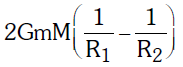
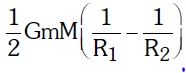
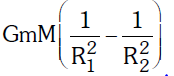
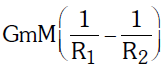
The additional kinetic energy to be provided to a satellite of mass m revolving around a planet of mass M, to transfer it from a circular orbit of radius R1 to another of radius R2(R2 > R1) is :

1.
2.
3.
4.
View Answer

The additional kinetic energy required to transfer a satellite from a circular orbit of radius \( R_1 \) to \( R_2 \) is the difference in kinetic energy between the two orbits.

Kinetic energy in a circular orbit is:

\[
K = \frac{GMm}{2R}
\]

The kinetic energy difference is:

\[
\Delta K = \frac{GMm}{2R_1} - \frac{GMm}{2R_2}
\]

Simplifying:

\[
\Delta K = \frac{GMm}{2} \left( \frac{1}{R_1} - \frac{1}{R_2} \right)
\]

So, the additional kinetic energy is:

\[
\Delta K = \frac{GMm}{2} \left( \frac{1}{R_1} - \frac{1}{R_2} \right)
\]

Question 53: moderate

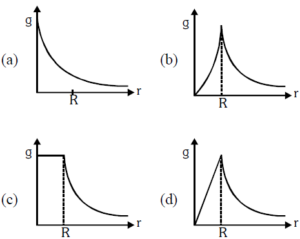
The dependence of acceleration due to gravity ‘g’ on the distance ‘r’ from the centre of the earth, assumed to be a sphere of radius R of uniform density, is as shown in figure below:-

The correct figure is :

1. (a)
2. (b)
3. (c)
4. (d)
View Answer

\[ g= \frac{GMr}{R^{3}}  \] for internal point

\[ g= \frac{GM}{r^{2}}  \] for external point


Question 54: moderate

A particle of mass M is situated at the centre of a spherical shell of same mass and radius a. The gravitational potential at a point situated at a/2 distance from the centre, will be :

1. \[ \frac{-4GM}{a} \]
2. \[ \frac{-3GM}{a} \]
3. \[ \frac{-2GM}{a} \]
4. \[ \frac{-GM}{a} \]
View Answer

Total gravitational potential at a point \( r = \frac{a}{2} \):

1. Potential due to the mass at the center:
The gravitational potential at a distance \( r \) from a point mass \( M \) is given by:
\[
V_{\text{center}} = -\frac{GM}{r}
\]
At \( r = \frac{a}{2} \), this becomes:
\[
V_{\text{center}} = -\frac{GM}{\frac{a}{2}} = -\frac{2GM}{a}
\]

2. **Potential due to the spherical shell**:
Inside a spherical shell, the gravitational potential is constant and equal to the potential at the surface, which is:
\[
V_{\text{shell}} = -\frac{GM}{a}
\]

### Total potential at \( r = \frac{a}{2} \):

The total gravitational potential is the sum of the potentials due to the mass at the center and the shell:
\[
V_{\text{total}} = V_{\text{center}} + V_{\text{shell}} = -\frac{2GM}{a} - \frac{GM}{a} = -\frac{3GM}{a}
\]

So, the gravitational potential at a distance \( \frac{a}{2} \) from the center is:
\[
V = -\frac{3GM}{a}
\]

Question 55: easy

Two identical spheres each of mass M and radius R are separated by a centre to centre distance 10R. The gravitational force on mass m placed at the midpoint of the line joining the centres of the spheres is :

1. zero
2. 2GMm/25R²
3. GMm/25R²
4. GMm/100R²
View Answer

At the midpoint, the gravitational forces exerted by the two identical spheres on the mass \( m \) have the same magnitude but act in opposite directions. Since these forces cancel each other out completely, the net gravitational force on the mass \( m \) is:

\[
F = 0
\]

Question 56: easy

Dimensions of gravitational constant are :

1. [ML²T²]
2. [M¹L³T–²]
3. [M°L³T²]
4. [M–¹L³T–²]
View Answer

To find the dimensions of the gravitational constant \( G \), use Newton's law of gravitation:

\[
F = \frac{G M_1 M_2}{r^2}
\]

Where:
- \( F \) is force (with dimensions \( [M L T^{-2}] \)),
- \( M_1 \) and \( M_2 \) are masses (with dimensions \( [M] \)),
- \( r \) is distance (with dimensions \( [L] \)).

Rearranging for \( G \):

\[
G = \frac{F r^2}{M_1 M_2}
\]

Substitute the dimensions:

\[
G = \frac{[M L T^{-2}] [L^2]}{[M][M]}
\]

Simplify:

\[
G = [M^{-1} L^3 T^{-2}]
\]

Thus, the dimensions of \( G \) are \( [M^{-1} L^3 T^{-2}] \).