Gravitation - NEET Physics Questions
← All Chapters

Gravitation

Question 41: moderate

Weight of 1 kg becomes 1/6th on moon. If the radius of moon is \( 1.768 × 10^{6} m \), then the mass of moon will be :

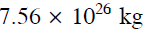
1.
2.
3.
4.
View Answer

The weight of an object on the Moon is given by:

\[
W_{\text{moon}} = \frac{1}{6} W_{\text{earth}}
\]

Weight is related to the gravitational acceleration \( g \) by:

\[
W = mg
\]

Thus,

\[
g_{\text{moon}} = \frac{1}{6} g_{\text{earth}}
\]

The formula for gravitational acceleration is:

\[
g = \frac{GM}{R^2}
\]

Where:
- \( G \) is the gravitational constant,
- \( M \) is the mass of the Moon,
- \( R \) is the radius of the Moon.

Given:
- \( g_{\text{earth}} = 9.8 \, \text{m/s}^2 \),
- \( g_{\text{moon}} = \frac{1}{6} \times 9.8 = 1.633 \, \text{m/s}^2 \),
- \( R_{\text{moon}} = 1.768 \times 10^6 \, \text{m} \).

Now, solve for \( M_{\text{moon}} \) using:

\[
g_{\text{moon}} = \frac{G M_{\text{moon}}}{R_{\text{moon}}^2}
\]

Rearranging for \( M_{\text{moon}} \):

\[
M_{\text{moon}} = \frac{g_{\text{moon}} R_{\text{moon}}^2}{G}
\]

Substitute values:

\[
M_{\text{moon}} = \frac{1.633 \times (1.768 \times 10^6)^2}{6.674 \times 10^{-11}}
\]

Calculating this gives:

\[
M_{\text{moon}} \approx 7.35 \times 10^{22} \, \text{kg}
\]

Thus, the mass of the Moon is approximately \( 7.35 \times 10^{22} \, \text{kg} \).

Question 42: difficult

If 100 kg mass is split into two parts and then separated by certain distance. then what ratio of masses so that gravitational force between them is maximum :

1. 2/3
2. 1/2
3. 1
4. 1/3
View Answer

The gravitational force between two masses \( m_1 \) and \( m_2 \) is given by Newton's law of gravitation:

\[
F = \frac{G m_1 m_2}{r^2}
\]

Let the total mass be \( M = 100 \, \text{kg} \), and split it into two parts: \( m_1 = x \) and \( m_2 = 100 - x \).

The gravitational force becomes:

\[
F = \frac{G x (100 - x)}{r^2}
\]

To maximize \( F \), we need to maximize \( x(100 - x) \), which is a quadratic function. The product \( x(100 - x) \) is maximized when \( x = 50 \).

Thus, the ratio of the two masses is:

\[
m_1 : m_2 = 50 : 50 = 1:1
\]

Therefore, the masses should be in a 1:1 ratio for the gravitational force to be maximum.

Question 43: moderate

The diameter of two planets are in the ratio 4:1 and their mean densities in the ratio 1:2 the amocceleration due to gravity on the planets will be in ratio :

1. 1 : 2
2. 2 : 3
3. 2 : 1
4. 4 : 1
View Answer

The formula for acceleration due to gravity \( g \) on a planet is:

\[
g = \frac{GM}{R^2}
\]

Where:
- \( G \) is the gravitational constant,
- \( M \) is the mass of the planet,
- \( R \) is the radius of the planet.

Mass \( M \) is related to density \( \rho \) and volume \( V \):

\[
M = \rho V = \rho \frac{4}{3} \pi R^3
\]

Substituting into the equation for \( g \):

\[
g = \frac{G \rho \frac{4}{3} \pi R^3}{R^2} = \frac{4}{3} \pi G \rho R
\]

Thus, \( g \propto \rho R \).

Given:
- Diameter ratio \( R_1 : R_2 = 4:1 \), so \( R_1 : R_2 = 4:1 \),
- Density ratio \( \rho_1 : \rho_2 = 1:2 \).

Now,

\[
g_1 : g_2 = (\rho_1 R_1) : (\rho_2 R_2) = (1 \times 4) : (2 \times 1) = 4:2 = 2:1
\]

Thus, the ratio of acceleration due to gravity on the planets is \( 2:1 \).

Question 44: moderate

The change in the value of g at a height h above the surface of the earth is the same as at a depth d below the earth when both d and h are much smaller than the radius of the earth, which one of the following is correct ?

1. d = h/2
2. d = 3h/2
3. d = 2h
4. d = h
View Answer

The change in the value of \( g \) at height \( h \) above the surface of the Earth and at depth \( d \) below the surface can be expressed using the following formulas:

1. **At height \( h \)**:
\[
g_h = g \left(1 - \frac{2h}{R}\right) \quad \text{(for small } h\text{)}
\]

The change in \( g \) is:
\[
\Delta g_h = g - g_h = g \frac{2h}{R} = \frac{2gh}{R}.
\]

2. **At depth \( d \)**:
\[
g_d = g \left(1 - \frac{d}{R}\right) \quad \text{(for small } d\text{)}
\]

The change in \( g \) is:
\[
\Delta g_d = g - g_d = g \frac{d}{R}.
\]

Setting the changes equal gives:

\[
\frac{2gh}{R} = \frac{g d}{R}.
\]

Cancelling \( g \) and \( R \) (assuming they are non-zero):

\[
2h = d.
\]

Thus, the relation between depth \( d \) and height \( h \) is:

\[
d = 2h.
\]

Question 45: easy

If the rotational motion of earth is suddenly stopped then which one is correct :

1. Value of g decreases on all places of earth
2. Value of g increases on all places of earth except pole
3. Value of g increases on all places of earth
4. Value of g decreases on all places of earth except equator
View Answer

If the Earth's rotational motion were suddenly stopped, the value of \( g \) would effectively increase everywhere except at the poles due to the following reasons:

1. Centrifugal Force: The Earth's rotation creates a centrifugal force that slightly counteracts the force of gravity. At the equator, this effect is the greatest, reducing the apparent weight and thus the effective value of \( g \). When rotation stops, this centrifugal force disappears.

2. At the Poles: At the poles, there is no centrifugal force due to rotation since they are the axis of rotation. Therefore, the value of \( g \) would remain unchanged at the poles.

Consequently, \( g \) would increase at all places on Earth except at the poles, where it would stay the same.

Question 46: easy

The mass of the moon is about 1.2% of the mass of the earth. compared to the gravitational force the earth exerts on the moon, the gravitational force the moon exerts on earth :

1. Is the same
2. is smaller
3. Is greater
4. Varier with its phase
View Answer

From Newton's Third law of motion force applied by object A on B and Force applied by B on A will have equal magnitude.

Question 47: easy

The average density of the earth :

1. does not depend on g
2. is a complex function of g
3. is directly proportional to g
4. is inversely proportional to g
View Answer

The average density of the Earth (\( \rho \)) is directly proportional to the acceleration due to gravity (\( g \)) at the surface due to the relationship expressed by the formula:

\[
g = \frac{G M}{R^2},
\]

where:
- \( G \) is the gravitational constant,
- \( M \) is the mass of the Earth,
- \( R \) is the radius of the Earth.

The mass \( M \) can be expressed in terms of density and volume:

\[
M = \rho V = \rho \left( \frac{4}{3} \pi R^3 \right).
\]

Substituting this into the equation for \( g \):

\[
g = \frac{G \left( \rho \cdot \frac{4}{3} \pi R^3 \right)}{R^2} = \frac{4\pi G \rho R}{3}.
\]

This shows that \( g \) is directly proportional to \( \rho \) (as \( R \) and \( G \) are constants), meaning that as the average density of the Earth increases, the value of \( g \) also increases.

Question 48: moderate

Two types of balances, the beam balance and the spring balance are commonly used for measuring weight at shops. If we are at the moon, we can continue to use :

1. Only the beam type balance without any change
2. Only the spring balance without any change
3. both the balances without any change
4. Neither of the two balances without making any change
View Answer

On the Moon, the acceleration due to gravity is weaker (about \( \frac{1}{6} \) of that on Earth), affecting how a spring balance measures weight.

A spring balance relies on the gravitational force to measure weight based on the stretch of the spring, so it would give a lower reading on the Moon.

In contrast, a beam balance compares masses based on equilibrium, unaffected by gravity. Thus, it can be used without any change to measure weight accurately on the Moon.

Question 49: easy

A body released from a height h takes time t to reach earth’s surface. The time taken by the same body released from the same height to reach the moon’s surface is :

1. t
2. 6t
3. t/6
4. √6t
View Answer

The time taken for an object to fall freely from a height \( h \) is given by the equation:

\[
h = \frac{1}{2} g t^2,
\]

where \( g \) is the acceleration due to gravity.

1. For Earth:
\[
h = \frac{1}{2} g_E t^2 ; t = \sqrt{\frac{2h}{g_E}}.
\]

2. For the Moon, where \( g_M \approx \frac{1}{6} g_E \):
\[
h = \frac{1}{2} g_M t_m^2 ; t_m = \sqrt{\frac{2h}{g_M}} = \sqrt{\frac{2h}{\frac{1}{6} g_E}} = \sqrt{12 \cdot \frac{2h}{g_E}}.
\]

This can be simplified using the time \( t \) from Earth:

\[
t_m = \sqrt{6} \cdot t = \sqrt{6} \cdot t.
\]

Thus, the time taken by the same body to reach the Moon's surface is approximately \( \sqrt{6} t \).

Question 50: moderate

The depth at which the effective value of acceleration due to gravity is g/4 is (R is radius of the earth) :

1. R
2. 3R/4
3. R/2
4. R/4
View Answer

To find the depth \( d \) at which the effective acceleration due to gravity is \( \frac{g}{4} \), we use the formula for gravity at depth:

\[
g_d = g \left(1 - \frac{d}{R}\right).
\]

Setting \( g_d = \frac{g}{4} \):

\[
\frac{g}{4} = g \left(1 - \frac{d}{R}\right).
\]

Dividing both sides by \( g \):

\[
\frac{1}{4} = 1 - \frac{d}{R}.
\]

Rearranging gives:

\[
\frac{d}{R} = 1 - \frac{1}{4} = \frac{3}{4}.
\]

Thus:

\[
d = \frac{3R}{4}.
\]

So, the depth at which the effective value of acceleration due to gravity is \( \frac{g}{4} \) is \( \frac{3R}{4} \).

