Power - NEET Physics Chapterwise MCQs & PYQs

NEET Power MCQs & PYQs

Question 1:

moderate

An engine pumps 400 kg of water through height of 10 m in 40 s. Find the power of the engine if its efficiency is 80% (g = 10 m/s²).

Power = Work Done / Time Taken

Here , Work Done = 400 ×10 ×10 J = 40000 J

Time Taken = 40 sec , So, 

Power = 40000/40 = 1000 W= 1 KW

Efficiency = Output Power/ Input Power × 100

⇒ 80 = 1000/ Input Power × 100

⇒Input Power = 1250 W= 1.25 KW
Question 2:

moderate

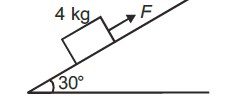
A block of mass 4 kg is pulled along a smooth inclined plane of inclination 30° with constant velocity 3 m/s as shown, power delivered by the force is

As the object is not moving with constant speed net force on it is zero.

so F = mg sin 30 °= 4 × 10 × ½= 20 N

Power is Dot product of force and velocity. So, P = 20 × 3 = 60 W

Question 3:

moderate

Water from a stream is falling on the blades of a turbine at the rate of 100 kg/s. If the height of the stream is 100 m, then power delivered to turbine is

Power is Rate of doing work. 

Power = mgh/t= (m/t)gh= 100 × 10 × 100 = 100 kW

Question 4:

moderate

A body is being moved from rest along a straight line by a machine delivering constant power. The speed of  body in time t is proportional to

Power = Constant (K)

F.v= K 

⇒m.(dv/dt).v = K

⇒m.v.dv = K.dt

Integrating we get,

⇒∫m.v.dv=∫K.dt 

⇒ mv²/2 = Kt

so, V α  t½

Question 5:

moderate

Water falls from a height of \(60\text{ m}\) at the rate of \(15\text{ kg/s}\) to operate a turbine. The losses due to frictional forces are 10% of energy. How much power is generated by the turbine (\(g = 10\text{ m/s}^2\)):

The input power is \(P_{\text{in}} = \frac{dm}{dt} gh = 15 \times 10 \times 60 = 9000\text{ W} = 9\text{ kW}\). Frictional losses are 10%, meaning the output efficiency is 90%. Thus, generated power is \(0.90 \times 9\text{ kW} = 8.1\text{ kW}\).

Question 6:

moderate

The position of a particle at any time \( t \) is given by \( x = t^2 + 1 \), where \( x \) is in m and \( t \) is in s. If a constant force of 8 N is acting on the particle, then the instantaneous power of the force at \( t = 1\text{ s} \) will be

The velocity of the particle is \( v = \frac{dx}{dt} = 2t \). At \( t = 1\text{ s} \), \( v = 2\text{ m/s} \). The instantaneous power is \( P = F \cdot v = 8\text{ N} \times 2\text{ m/s} = 16\text{ W} \).

Question 7:

moderate

An electric lift with a maximum load of $2000\text{ kg}$ (lift + passengers) is moving up with a constant speed of $1.5\text{ ms}^{-1}$. The frictional force opposing the motion is $3000\text{ N}$. The minimum power delivered by the motor to the lift in watts is : ($g = 10\text{ ms}^{-2}$)

(2022)

Total upward force required equals the sum of weight and frictional force: $F = mg + f = (2000 \times 10) + 3000 = 23000\text{ N}$. Minimum power $P = F \cdot v = 23000 \times 1.5 = 34500\text{ W}$.

Question 8:

moderate

Water falls from a height of $60\text{ m}$ at the rate of $15\text{ kg/s}$ to operate a turbine. The losses due to frictional force are $10\%$ of the input energy. How much power is generated by the turbine? ($g = 10\text{ m/s}^2$)

(2021, 2008)

Input power is $P_{\text{in}} = \left(\frac{dm}{dt}\right)gh = 15 \times 10 \times 60 = 9000\text{ W} = 9\text{ kW}$. With $10\%$ frictional losses, efficiency is $90\%$. Power generated = $90\% \text{ of } 9\text{ kW} = 8.1\text{ kW}$.

Question 9:

moderate

A body of mass $1\text{ kg}$ begins to move under the action of a time dependent force $\vec{F} = (2t\hat{i} + 3t^2\hat{j})\text{ N}$, where $\hat{i}$ and $\hat{j}$ are unit vectors along $x$ and $y$ axis. What power will be developed by the force at the time $t$?

(2016 – I)

Velocity is found by integrating acceleration: $\vec{v} = \int \frac{\vec{F}}{m} dt = (t^2\hat{i} + t^3\hat{j})$. Power is given by the dot product $P = \vec{F} \cdot \vec{v} = (2t)(t^2) + (3t^2)(t^3) = 2t^3 + 3t^5\text{ W}$.

Question 10:

moderate

A particle of mass $m$ is driven by a machine that delivers a constant power $k$ watts. If the particle starts from rest the force on the particle at time $t$ is:

(2015)

Using constant power $P = Fv$ and $P = mv\frac{dv}{dt}$, integrating gives velocity $v = \sqrt{\frac{2kt}{m}}$. Since force $F = \frac{P}{v}$, substituting velocity yields $F = \sqrt{\frac{mk}{2}} t^{-1/2}$.