Question 1:
easyA 1 kg mass has a kinetic energy of 1 joule when its speed is :
Question 1:
easyA 1 kg mass has a kinetic energy of 1 joule when its speed is :
Question 2:
easyWhen the velocity of a body is doubled :
Momentum of an object is P = m.v
So, when velocity is doubled momentum also doubles
Question 3:
moderateTwo masses of 1 g and 4 g are moving with equal kinetic energies. The ratio of the magnitudes of their linear momenta is
Kinetic Energy is given by K = ½mv² and Momentum is P=m.v, relation between kinetic energy and momentum is
K= P²/2m so P=√(2mK)
So P1/P2= √(m1)/√(m2)= √1/√4 = 1:2
Question 4:
moderateIf the kinetic energy of a body is increased by 300%, its momentum will increase by :
Relation between Kinetic Energy and Momentum is
P = √(2mK)
When kinetic energy is increased by 300 % it becomes 4K so new momentum is
P1= √(2m.4K) =2P
Question 5:
moderateIf the kinetic energy of a body is increased by 3%, its momentum will increase by :
Question 6:
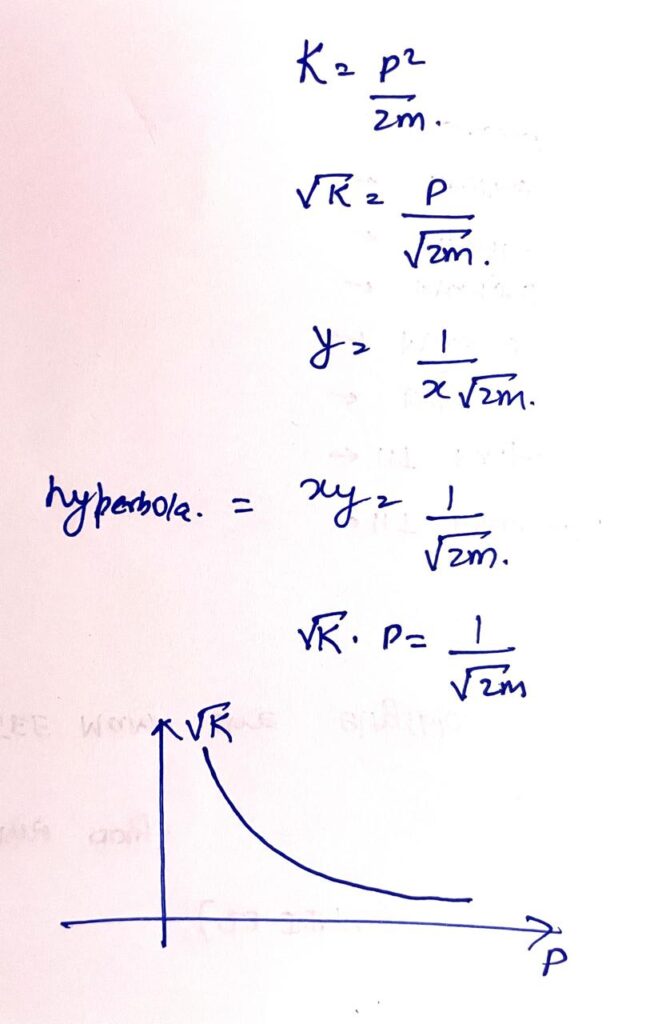
moderateThe graph between √E and 1/p is (E = kinetic energy and p = momentum):
Question 7:
easyIf the kinetic energy of a body increases by 800%, its momentum increases by
The momentum \(P\) is related to kinetic energy \(K\) by \(P = \sqrt{2mK}\). An 800% increase means the new kinetic energy is \(K' = 9K\). Thus, the new momentum is \(P' = \sqrt{9} P = 3P\), representing an increase of 200%.
Question 8:
easyTwo masses \( 4m \) and \( 9m \) move with equal kinetic energy. The ratio of the magnitude of their momenta is:
Since kinetic energy \( K \) is the same for both masses, the momentum is proportional to the square root of the mass, \( p = \sqrt{2mK} \). Thus, the ratio of their momenta is \( \frac{p_1}{p_2} = \sqrt{\frac{4m}{9m}} = \frac{2}{3} \).
Question 9:
easyTwo masses \(1\text{ g}\) and \(9\text{ g}\) are moving with equal kinetic energies. The ratio of the magnitudes of their respective linear momenta is
Since linear momentum \(p = \sqrt{2mK}\) and kinetic energy \(K\) is constant, \(p \propto \sqrt{m}\). Therefore, the ratio of momenta is \(\frac{p_1}{p_2} = \sqrt{\frac{1}{9}} = 1:3\).
Question 10:
easyAssertion (A): A body cannot have kinetic energy without having linear momentum but it can have momentum without having mechanical energy.
Reason (R): Linear momentum and energy have same dimensions.
Assertion (A) is false:
If a body has linear momentum (\(p \neq 0\)), it must have velocity (\(v \neq 0\)), which implies it must also have kinetic energy (\(KE = \frac{1}{2}mv^2 \neq 0\)). Since kinetic energy is a component of mechanical energy, it cannot have momentum without mechanical energy.
Reason (R) is false: Linear momentum has dimensions \(MLT^{-1}\) while energy has dimensions \(ML^2T^{-2}\), which are different.