A cylinder of capacity 20 litres is filled with H2 gas. The total average kinetic energy of translatory motion of its molecules is \( 1.5\times 10^{5}\) J. The pressure of hydrogen in the cylinder is
The total average kinetic energy \( E \) of translatory motion for an ideal gas is given by:
\[
E = \frac{3}{2} nRT
\]
where:
- \( n \) is the number of moles,
- \( R \) is the gas constant (\( 8.314 \, \text{J/mol·K} \)),
- \( T \) is the temperature in Kelvin.
We can rearrange to find \( nRT \):
\[
nRT = \frac{2}{3} E
\]
The ideal gas law also gives us:
\[
PV = nRT
\]
Thus,
\[
P = \frac{nRT}{V} = \frac{\frac{2}{3} E}{V}
\]
Substitute \( E = 1.5 \times 10^5 \, \text{J} \) and \( V = 20 \, \text{litres} = 20 \times 10^{-3} \, \text{m}^3 \):
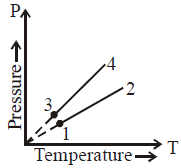
Pressure versus temperature graph of an ideal gas of equal number of moles (μ) of different volumes are plotted as shown in figure. Choose the correct alternative :
Thank you for the clarification. Given the correct answer, let's interpret the graph accordingly.
In this pressure (\( P \)) vs. temperature (\( T \)) graph:
1. **Parallel Lines**: When two lines have the same slope, it implies they have the same volume. This is because the slope in a \( P \)-\( T \) graph (for constant \( V \)) is given by \( \frac{nR}{V} \).
- Since lines **1** and **2** are parallel, we have \( V_1 = V_2 \).
- Similarly, lines **3** and **4** are parallel, so \( V_3 = V_4 \).
2. **Comparing Slopes**: The line with a steeper slope corresponds to a smaller volume, and the line with a shallower slope corresponds to a larger volume.
- Since lines 1 and 2 have a shallower slope compared to lines 3 and 4, we conclude that \( V_1 = V_2 > V_3 = V_4 \).
Final Answer:
- \( V_1 = V_2 \), \( V_3 = V_4 \), and \( V_2 > V_3 \).
A mixture of n1 moles of monoatomic gas and n2 moles of diatomic gas has
\[ \frac{C_{p}}{C_{v}}=\gamma=1.5 \], then :
For a mixture of \( n_1 \) moles of a monatomic gas and \( n_2 \) moles of a diatomic gas, the ratio \( \gamma = \frac{C_p}{C_v} \) of the mixture is given by:
1. Molar heat capacities:
- For a monatomic gas: \( C_{v, \text{mono}} = \frac{3}{2} R \) and \( C_{p, \text{mono}} = \frac{5}{2} R \).
- For a diatomic gas: \( C_{v, \text{di}} = \frac{5}{2} R \) and \( C_{p, \text{di}} = \frac{7}{2} R \).
2. Total heat capacities:
- Total \( C_v = n_1 \cdot \frac{3}{2} R + n_2 \cdot \frac{5}{2} R \).
- Total \( C_p = n_1 \cdot \frac{5}{2} R + n_2 \cdot \frac{7}{2} R \).
Since \(\text{N}_2\) is 14 times heavier than \(\text{H}_2\), we have \( m_{\text{N}_2} = 14 \, m_{\text{H}_2} \) and \( T_{\text{N}_2} = 27^\circ \text{C} = 300 \, \text{K} \).
A mixture of 2 moles of helium gas (atomic mass = 4 amu) and 1 mole of argon gas (atomic mass = 40 amu) is kept at 300 K in a container. The ratio of the rms speeds \( \left( \frac{v_{rms}(helium)}{v_{rms}\left( argon \right)} \right) \) is:
The root mean square (rms) speed \( v_{\text{rms}} \) of a gas is given by:
\[
v_{\text{rms}} = \sqrt{\frac{3RT}{M}}
\]
where \( M \) is the molar mass.
For helium (\( M = 4 \, \text{g/mol} \)) and argon (\( M = 40 \, \text{g/mol} \)) at the same temperature, the ratio of their rms speeds is:
A gas mixture consists of 2 moles of oxygen and 4 moles of argon at temperature T. Neglecting all vibrational modes the total internal energy of the system is :
For a gas mixture of oxygen (\(\text{O}_2\)) and argon (\(\text{Ar}\)):
1. **Oxygen (\(\text{O}_2\))** is diatomic, so its internal energy per mole is:
\[
U_{\text{O}_2} = \frac{5}{2} RT
\]
For 2 moles, \( U_{\text{O}_2} = 2 \times \frac{5}{2} RT = 5 RT \).
2. **Argon (\(\text{Ar}\))** is monatomic, so its internal energy per mole is:
\[
U_{\text{Ar}} = \frac{3}{2} RT
\]
For 4 moles, \( U_{\text{Ar}} = 4 \times \frac{3}{2} RT = 6 RT \).
2. Since kinetic energy depends only on temperature, set the temperature \( T_{\text{O}_2} = T_{\text{H}_2} = 200 \, \text{K} \).
Therefore, the temperature at which \(\text{O}_2\) has the same mean kinetic energy as \(\text{H}_2\) at \(-73^\circ \text{C}\) is \(200 \, \text{K}\).
According to kinetic theory of gases : (A) Collisions are always elastic (B) There is no force of attraction among the molecules (C) Only a small number of molecules have very high velocity (D) Between collisions, the molecules move in straight lines with constant velocities
According to the kinetic theory of gases:
- (A) Collisions are always elastic: Gas molecule collisions do not lose kinetic energy, so they are elastic.
- (B) There is no force of attraction among the molecules: Assumption of ideal gases is no intermolecular forces.
- (C) Only a small number of molecules have very high velocity: Most molecules have moderate speeds; only a few have very high speeds.
- (D) Between collisions, the molecules move in straight lines with constant velocities: Molecules move with constant speed in straight lines until they collide.
All options are correct as per the assumptions of kinetic theory.