Thermal Physics - NEET Physics Chapterwise MCQs & PYQs

NEET Thermal Physics MCQs & PYQs

Question 41:

difficult

10 gm of ice at –20°C is added to 10 gm of water at 50°C Specific heat of water = 1 cal / gm-°C, specific heat of ice = 0.5 cal /gm-°C. Latent heat of ice = 80 cal /gm. Then, resulting temperature is :

1. Heat gained by ice to reach 0°C:
\[
Q_{\text{ice heating}} = 10 \, \text{g} \cdot 0.5 \, \text{cal/g°C} \cdot 20°C = 100 \, \text{cal}
\]

2. Heat gained by ice to melt:
\[
Q_{\text{ice melting}} = 10 \, \text{g} \cdot 80 \, \text{cal/g} = 800 \, \text{cal}
\]

Total heat gained by ice:
\[
Q_{\text{total ice}} = 100 \, \text{cal} + 800 \, \text{cal} = 900 \, \text{cal}
\]

3. Heat lost by water:
\[
Q_{\text{water cooling}} = 10 \, \text{g} \cdot 1 \, \text{cal/g°C} \cdot (50 - T) = 500 - 10T \, \text{cal}
\]

4. Set heat gained equal to heat lost:
\[
500 - 10T = 900 \Rightarrow -10T = 400 \Rightarrow T = -40°C
\]

Since this temperature is below 0°C, all the ice will not melt.

5. Equilibrium Calculation:
Let \( x \) be the mass of ice that melts:
\[
500 = 70x + 100 \Rightarrow 400 = 70x \Rightarrow x \approx 5.71 \, \text{g}
\]

Result:
The final temperature of the system will be **0°C**.
Question 42:

moderate

Two spheres A and B have diameters in the ratio 1 : 2, densities in the ratio 2 : 1 and specific heats in the ratio 1 : 3; find the ratio of their thermal capacities :

Given:

- Diameter ratio = 1:2
- Density ratio = 2:1
- Specific heat ratio = 1:3

Step 1: Mass ratio
Mass is proportional to \( \text{density} \times \text{volume} \).
Volume is proportional to the cube of the diameter, so the volume ratio is \( (1:2)^3 = 1:8 \).

Thus, mass ratio = \( \text{density} \times \text{volume} = \frac{2 \times 1}{1 \times 8} = 1:4 \).

Step 2: Thermal capacity ratio
Thermal capacity = mass × specific heat.

So, thermal capacity ratio = \( \frac{1 \times 1}{4 \times 3} = 1:12 \).

Final Answer:
The ratio of the thermal capacities is 1:12.

Question 43:

moderate

Two liquids A and B are at temperatures of 75°C and 15°C. Their masses are in the ratio of 2 : 3 and their specific heats in the ratio 3 : 4. What is the resulting temperature :

To find the resulting temperature when two liquids A and B are mixed, we can use the principle of conservation of heat energy: the heat lost by the hotter liquid (A) equals the heat gained by the cooler liquid (B).

Given:
- Temperature of liquid A = 75°C
- Temperature of liquid B = 15°C
- Masses of A and B are in the ratio 2:3, so let the masses of A and B be \( 2m \) and \( 3m \), respectively.
- Specific heats of A and B are in the ratio 3:4, so let the specific heats of A and B be \( 3c \) and \( 4c \), respectively.

Let the final temperature of the mixture be \( T \).

Step 1: Heat lost by liquid A (hotter liquid):
\[
Q_A = \text{mass of A} \times \text{specific heat of A} \times (\text{initial temp of A} - T)
\]
\[
Q_A = 2m \times 3c \times (75 - T) = 6mc(75 - T)
\]

Step 2: Heat gained by liquid B (cooler liquid):
\[
Q_B = \text{mass of B} \times \text{specific heat of B} \times (T - \text{initial temp of B})
\]
\[
Q_B = 3m \times 4c \times (T - 15) = 12mc(T - 15)
\]

Step 3: Apply the conservation of heat:
Heat lost by A = Heat gained by B
\[
6mc(75 - T) = 12mc(T - 15)
\]

 Step 4: Simplify and solve for \( T \):
Cancel out \( mc \) from both sides:
\[
6(75 - T) = 12(T - 15)
\]
Expand both sides:
\[
450 - 6T = 12T - 180
\]
Combine like terms:
\[
450 + 180 = 12T + 6T
\]
\[
630 = 18T
\]
Solve for \( T \):
\[
T = \frac{630}{18} = 35 \, ^\circ\text{C}
\]

Final Answer:
The resulting temperature is 35°C.

Question 44:

moderate

Steam is passed into 54 gm of water at 30°C till the temperature of mixture becomes 90°C. If the latent heat of steam is 530 cal/gm, the mass of the mixture will be :

Here’s a short solution:

Given

- Mass of water = 54 gm
- Initial temperature of water = 30°C, Final temperature = 90°C
- Latent heat of steam = 530 cal/gm
- Specific heat of water = 1 cal/gm°C

Step 1: Heat gained by water to reach 90°C:

\[
Q_{\text{gained}} = m_{\text{water}} \times c_{\text{water}} \times \Delta T = 54 \times 1 \times (90 - 30) = 3240 \, \text{cal}
\]

Step 2: Heat lost by steam:

\[
Q_{\text{lost}} = m_s \times (530 + 10) = 540 m_s
\]

Step 3: Equating heat gained and heat lost:

\[
3240 = 540 m_s \quad \Rightarrow \quad m_s = \frac{3240}{540} = 6 \, \text{gm}
\]

Step 4: Total mass of the mixture:

\[
m_{\text{mixture}} = 54 \, \text{gm} + 6 \, \text{gm} = 60 \, \text{gm}
\]

Final Answer:
The mass of the mixture is 60 grams.

Question 45:

easy

The temperature of a gas contained in a closed vessel increases by 2°C, when the pressure is increased by 2%. The initial temperature of the gas is :

Given:

- The increase in temperature \(\Delta T = 2^\circ \text{C} = 2 \text{ K}\)
- The increase in pressure \(\frac{\Delta P}{P} = 2\% = 0.02\)

Using the relation for a gas at constant volume, \(\frac{\Delta P}{P} = \frac{\Delta T}{T}\):

\[
0.02 = \frac{2}{T}
\]

Solving for \(T\):

\[
T = \frac{2}{0.02} = 100 \text{ K}
\]

Answer: \(T = 100 \, \text{K}\)

Question 46:

moderate

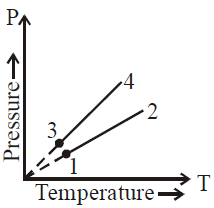
Pressure versus temperature graph of an ideal gas of equal number of moles (μ) of different volumes are plotted as shown in figure. Choose the correct alternative :

For an ideal gas, at constant volume, the pressure \( P \) is directly proportional to the temperature \( T \) (Gay-Lussac's Law):

\[
P \propto T
\]

In the graph, each line represents a pressure-temperature relationship at different volumes. A steeper slope indicates a smaller volume (since \( P = \frac{nRT}{V} \) and a higher \( V \) gives a less steep line).

From the figure:
1. Lines \( 1 \) and \( 2 \) have the same slope, indicating \( V_1 = V_2 \).
2. Lines \( 3 \) and \( 4 \) also have the same slope, indicating \( V_3 = V_4 \).
3. The slope of lines \( 3 \) and \( 4 \) is steeper than that of lines \( 1 \) and \( 2 \), meaning \( V_2 > V_3 \).

Thus, the correct answer is \( V_1 = V_2 \), \( V_3 = V_4 \), and \( V_2 > V_3 \).

Question 47:

easy

An ideal gas has a volume of 3V at 2 atmosphere pressure. Keeping the temperature constant, its pressure is doubled. The volume of the gas will be :

Since the temperature is constant, we can use Boyle's Law, which states that \( P_1 V_1 = P_2 V_2 \).

Given:
- Initial pressure, \( P_1 = 2 \) atm
- Initial volume, \( V_1 = 3V \)
- Final pressure, \( P_2 = 2 \times P_1 = 4 \) atm

Using Boyle's Law:

\[
P_1 V_1 = P_2 V_2
\]
\[
2 \times 3V = 4 \times V_2
\]
\[
6V = 4V_2
\]
\[
V_2 = \frac{6V}{4} = 1.5V
\]

So, the final volume \( V_2 \) is \( 1.5V \).

Question 48:

difficult

A closed vessel A having volume V contains N2 gas at pressure P and temperature T. Another closed vessel B having the same volume V contains. He at the same pressure P but temperature 2T. The ratio of masses of N2 and He in the vessels A and B is :

To find the ratio of the masses of \( \text{N}_2 \) and \( \text{He} \) in vessels \( A \) and \( B \), we use the ideal gas law:

\[
PV = \frac{m}{M} RT
\]

where:
- \( m \) is the mass of the gas,
- \( M \) is the molar mass,
- \( P, V, R, T \) are pressure, volume, gas constant, and temperature, respectively.

For vessel \( A \) (containing \( \text{N}_2 \)):
\[
m_{\text{N}_2} = \frac{PVM_{\text{N}_2}}{RT}
\]

For vessel \( B \) (containing \( \text{He} \) at temperature \( 2T \)):
\[
m_{\text{He}} = \frac{PV M_{\text{He}}}{R \cdot 2T} = \frac{PVM_{\text{He}}}{2RT}
\]

Now, the ratio of the masses \( \frac{m_{\text{N}_2}}{m_{\text{He}}} \) is:

\[
\frac{m_{\text{N}_2}}{m_{\text{He}}} = \frac{\frac{PVM_{\text{N}_2}}{RT}}{\frac{PVM_{\text{He}}}{2RT}} = \frac{M_{\text{N}_2}}{M_{\text{He}}} \times 2
\]

Since \( M_{\text{N}_2} = 28 \) and \( M_{\text{He}} = 4 \):

\[
\frac{m_{\text{N}_2}}{m_{\text{He}}} = \frac{28}{4} \times 2 = 14
\]

Thus, the ratio of masses of \( \text{N}_2 \) to \( \text{He} \) is  14:1.

Question 49:

easy

At a given volume and temperature, the pressure of a gas :

At constant volume and temperature, the ideal gas law is:

\[
PV = nRT
\]

Since \( n = \frac{\text{mass}}{\text{molar mass}} \), we can rewrite the equation as:

\[
P \propto \frac{\text{mass}}{M}
\]

Thus, for a given volume and temperature, the pressure \( P \) varies directly with the mass of the gas.

Question 50:

moderate

A given volume of air at 17°C exerts a pressure of 870 mm of mercury. The temperature at which the pressure becomes 1800 mm of Hg is :

To solve this, we can use Gay-Lussac's Law, which states:

\[
\frac{P_1}{T_1} = \frac{P_2}{T_2}
\]

Given:
- Initial pressure \( P_1 = 870 \, \text{mm Hg} \),
- Final pressure \( P_2 = 1800 \, \text{mm Hg} \),
- Initial temperature \( T_1 = 17^\circ \text{C} = 17 + 273 = 290 \, \text{K} \).

Rearrange to find \( T_2 \):

\[
T_2 = \frac{P_2 \times T_1}{P_1}
\]

Substitute the values:

\[
T_2 = \frac{1800 \times 290}{870}
\]

Calculating this:

\[
T_2 = 600 \, \text{K}
\]

So, the temperature at which the pressure becomes 1800 mm of Hg is  600 K.