Question 81:
difficultA ray of light falls on a transparent sphere with centre at C as shown in fig.
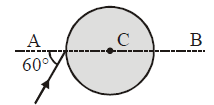
The ray emerges from the sphere parallel to line AB. The refractive index of the sphere is
Question 81:
difficultA ray of light falls on a transparent sphere with centre at C as shown in fig.
The ray emerges from the sphere parallel to line AB. The refractive index of the sphere is
Question 82:
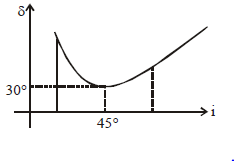
moderateVariation of angle of deviation δ versus angle of incidence for a prism is given the figure. The value of refractive index of prism :
Question 83:
easyRefractive index of a prism is \(cosec(A/2)\). Then minimum angle of deviation is :
Using the prism formula: \(mu = \frac{sin((A+\delta_m)/2)}{sin(A/2)}\). Substituting \(mu = cosec(A/2) =\frac{1}{sin(A/2)}\), we get \(sin((A+\delta_m)/2) = 1 ⇒ (A+\delta_m)/2 = 90^0 ⇒ \delta_m = 180^0 - A\).
Question 84:
easyA point object is moving towards a concave mirror of focal length \(25\text{ cm}\). When it is at a distance of \(20\text{ cm}\) from the mirror, its velocity is \(5\text{ cm/sec}\). Find velocity of image at that instant :-
Using the relation between object and image velocity: \(v_i = -m^2 v_o\). Here, magnification \(m = \frac{f}{f-u} =\frac{-25}{-25 - (-20)} = 5\). Hence, \(v_i = -5^2 \times 5 = -125\text{ cm/s}\). The speed is \(125\text{ cm/s}\).
Question 85:
easyAn object is mounted on a wall. Its image of equal size is to be obtained on a parallel wall with the help of a convex lens placed between these walls. The lens is kept at distance \(x\) in front of the second wall. The required focal length of the lens will be
For an image of equal size, the magnification is \(m = -1\), which means the image distance \(v = x\) is equal to the object distance \(u = x\). Using the lens formula: \(\frac{1}{f} = \frac{1}{v} + \frac{1}{u} = \frac{2}{x} ⇒ f = \frac{x}{2}\).
Question 86:
easyA lens of large focal length and large aperture is best suited as an objective of an astronomical telescope since
A larger aperture lens collects more light (better visibility and brightness), has a higher resolving power (better resolution), and hence satisfies all specified criteria.
Question 87:
easyA convex lens ‘A’ of focal length 20 cm and a concave lens ‘B’ of focal length 5 cm are kept along the same axis with a distance ‘\(d\)’ between them. If a parallel beam of light falling on ‘A’ leaves ‘B’ as a parallel beam, then the distance ‘\(d\)’ in cm will be
For an incoming parallel beam to emerge parallel from the combination, the focus of the first lens must coincide with the virtual focus of the second lens. Thus, \(d = f_1 - |f_2| = 20 - 5 = 15\) cm.
Question 88:
easyA glass sheet is grinded to form a double convex lens. The radius of curvature of two surfaces are 15 cm and 10 cm and the focal length of lens is 12 cm. Refractive index of glass sheet is
By Lens-maker's formula, \( \frac{1}{f} = (\mu - 1) \left(\frac{1}{R_1} - \frac{1}{R_2}\right) \). Substituting \( f = 12 \text{ cm} \), \( R_1 = 15 \text{ cm} \), and \( R_2 = -10 \text{ cm} \), we get \( \frac{1}{12} = (\mu - 1)\left(\frac{1}{15} + \frac{1}{10}\right) = (\mu - 1)\frac{1}{6} ⇒ \mu - 1 = 0.5 ⇒ \mu = 1.5 \).
Question 89:
easyDispersive power of a prism depends on
Dispersive power (\(\omega\)) of a prism depends only on the nature of the material of the prism, and is independent of the refracting angle and size of the prism.
Question 90:
easyIn the displacement method, a convex lens is placed in between an object and a screen. If magnification in the two positions are \(m_1\) and \(m_2\) \((m_1 > m_2)\) and the distance between two positions of the lens is \(x\), the focal length of the lens is
In displacement method, the magnification values are \(m_1 = \frac{v_1}{u_1}\) and \(m_2 = \frac{v_2}{u_2} = \frac{u_1}{v_1}\). Also, \(x = v_1 - u_1\). Thus, \(m_1 - m_2 = \frac{x}{f}\), which gives \(f = \frac{x}{m_1 - m_2}\).