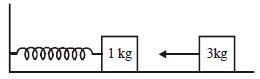
One end of an ideal spring is fixed with a wall and the other end is fixed with a block of mass 1 kg. Force constant of spring is 100 N/m and block is performing S.H.M. with amplitude 3 cm. When the block is at left extreme position, another block of mass 3 kg moving directly towards 1 kg block with velocity 80/3 cm/s collides and gets stuck to it. The amplitude of oscillation of the combined body is :
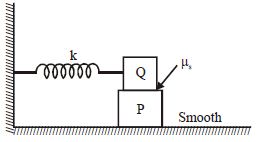
A block P of mass m is placed on a frictionless horizontal surface. Another block Q of same mass is kept on P and connected to the wall with the help of a spring of spring constant k as shown in the figure. μs is the coefficient of friction between P and Q. The blocks move together performing simple harmonic motion with amplitude A. The maximum value of the friction force between P and Q is :
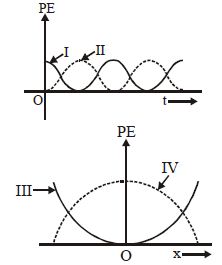
For a particle executing simple harmonic motion, the displacement x is given by x = A cosωt. Identify the graph which represents the variation of potential energy (PE) as function of time t and displacement x
\[ P.E = \frac{1}{2}Kx^{2} = \frac{1}{2}KA^{2}cos^{2}\left( \omega t \right) \]
A body is executing simple harmonic motion. At a displacement x, its potential energy is E1 and at a displacement y, its potential energy is E2. The potential energy E at a displacement (x + y) is :
A mass M is suspended from a spring of negligible mass. The spring is pulled a little and then released so that the mass executes SHM of time period T. If the mass is increased by m, the time period becomes 5T/3. Then the ratio of m/M is :
1. Initial Time Period:
\[
T = 2\pi \sqrt{\frac{M}{k}}
\]
2. New Time Period:
\[
\frac{5T}{3} = 2\pi \sqrt{\frac{M + m}{k}}
\]
3. Divide the New Time Period by the Initial Time Period:
A block whose mass is 1 kg is fastened to a spring. The spring has a spring constant of 50 Nm–¹. The block is pulled to a distance of x = 10 cm from its equilibrium position at x = 0 cm on a frictionless surface from rest at t = 0. The kinetic energy of the block when it is 5 cm away from the mean position is
The total mechanical energy of a spring-mass system in simple harmonic motion is E=1/2mω²A². Suppose the oscillating particle is replaced by another particle of double the mass while the amplitude A remains the same. The new mechanical energy will :
The total mechanical energy of a particle executing simple harmonic motion is E. When the displacement is half the amplitude its kinetic energy will be :
\[ K.E= \frac{1}{2}K\left(A^{2}-\left( \frac{A}{2}\right)^{2} \right)= \frac{3}{8} K A^{2} \]