Electric Flux - NEET Physics Chapterwise MCQs & PYQs
Rankers Physics
One Stop for Your NEET Physics Preparation
NEET Electric Flux MCQs & PYQs
Practice NEET Electric Flux Questions
Question 1:
moderate
Electric charges are distributed in a small volume. The flux of the electric field through a spherical surface of radius 10 cm surrounding the total charge is 25 V-m. The flux over a concentric sphere of radius 20 cm will be :
The electric flux through a spherical surface depends only on the total enclosed charge, as per Gauss's law:
\[
\Phi = \frac{Q_{\text{enc}}}{\epsilon_0}
\]
Since the total charge enclosed remains the same regardless of the sphere's radius, the flux through the concentric sphere of radius 20 cm will also be 25 V-m.
A square surface of side L metres is in the plane of the paper. A uniform electric field \(\overrightarrow{E} \)(volt/m), also in the plane of the paper, is limited only to the lower half of the square surface (see figure). The electric flux in SI units associated with the surface is :
Angle between area vector and Electric field is 90º. So Flux is zero.
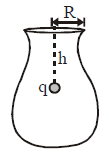
Consider the situation shown in figure. A point charge q is placed at a depth h= √3R exactly below the centre of mouth of a vessel whose open end is circular having a radius R. Calculate the electric flux through the lateral surface of this vessel.
To calculate the electric flux through the lateral surface of the vessel, we apply Gauss's law and consider the symmetry of the system.
---=====================================
Step-by-Step Solution:
1. Total Flux from the Charge \(q\):
The total flux emitted by the point charge \(q\) in all directions is:
\[
\Phi_{\text{total}} = \frac{q}{\varepsilon_0}.
\]
2. Flux Through the Circular Mouth:
Using the geometry of the vessel, the charge \(q\) is placed at a depth \(h = \sqrt{3}R\). The flux through the circular mouth of radius \(R\) can be calculated as:
\[
\Phi_{\text{mouth}} = \frac{q}{2\varepsilon_0}.
\]
3. Flux Through the Lateral Surface
By symmetry, the flux through the lateral surface is the remaining flux from the total flux after subtracting the flux through the mouth:
\[
\Phi_{\text{lateral}} = \Phi_{\text{total}} - \Phi_{\text{mouth}}.
\]
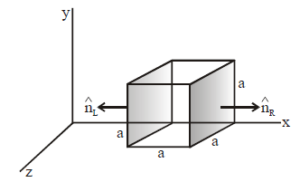
The electric field components in the given figure are \( E_{x}=\alpha x^{1/2}, E_{y}=E_{z}=0 \) in which \( \alpha=800NC^{-1}m^{-1/2}.\) The charge within the cube is if net flux through the cube is 1.05 N m²C–¹ (assume a = 0.1 m)
We are tasked with finding the charge enclosed within the cube using Gauss's Law:
A point charge + Q is positioned at the center of the base of a square pyramid as shown. The flux through one of the four identical upper faces of the pyramid is
Step-by-Step Explanation:
1. Flux through the Entire Pyramid:
The total charge enclosed by the pyramid is \(+Q\), and the total flux through the entire closed surface of the pyramid is given by Gauss's law:
\[
\Phi_{\text{total}} = \frac{Q}{\varepsilon_0}.
\]
2. Flux Distribution:
The pyramid has a square base and four triangular faces. However, **the charge \(+Q\) is located at the center of the base, not at the geometric center of the pyramid.** This means the flux through the base is not zero and contributes to the total flux.
3. Flux Through the Base:
Due to symmetry, half of the total flux passes through the square base:
\[
\Phi_{\text{base}} = \frac{\Phi_{\text{total}}}{2} = \frac{Q}{2\varepsilon_0}.
\]
4. Flux Through the Four Triangular Faces:
The remaining half of the total flux passes through the four triangular faces combined:
\[
\Phi_{\text{triangular (total)}} = \frac{\Phi_{\text{total}}}{2} = \frac{Q}{2\varepsilon_0}.
\]
5. Flux Through One Triangular Face:
Since the four triangular faces are identical, the flux is equally distributed among them:
\[
\Phi_{\text{face}} = \frac{\Phi_{\text{triangular (total)}}}{4} = \frac{\frac{Q}{2\varepsilon_0}}{4} = \frac{Q}{8\varepsilon_0}.
\]
Final Answer:
The flux through one triangular face is:
\[
{\frac{Q}{8\varepsilon_0}}.
\]
Since the charge \(Q\) is placed at the mouth of the conical flask, the flux through the flask corresponds to half the total flux (because the charge is symmetrically distributed above and below the mouth):
In a certain region of surface there exists a uniform electric field of \( 2\times 10^{3}\hat{k} \) V/m. A rectangular coil of dimensions 10 cm × 20 cm is placed in x-y plane. The electric flux through the coil is
The electric flux is given by:
\[
\Phi = \vec{E} \cdot \vec{A} = E A \cos\theta,
\]
where:
- \(E = 2 \times 10^3 \, \text{V/m}\),
- \(A = \text{area of the coil} = 10 \, \text{cm} \times 20 \, \text{cm} = 0.1 \, \text{m} \times 0.2 \, \text{m} = 0.02 \, \text{m}^2\),
- \(\theta = 0^\circ\) (field is perpendicular to the coil, as the coil is in the \(xy\)-plane and the field is along \(\hat{k}\)).
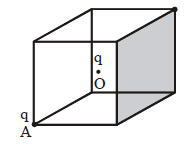
The length of each side of a cubical closed surface is l. If charge q is situated on one of the vertices of the cube, then find the flux passing through shaded face of the cube.
To find the flux through the shaded face of the cube, we use symmetry:
1. The total flux through a closed surface is given by Gauss's law:
\[
\Phi_{\text{total}} = \frac{q}{\varepsilon_0}.
\]
2. The charge \(q\) is at one vertex of the cube. It is shared equally among 8 cubes because the vertex belongs to 8 adjacent cubes. Hence, the charge effectively enclosed in one cube is:
\[
q_{\text{enclosed}} = \frac{q}{8}.
\]
3. The flux through the entire surface of one cube is:
\[
\Phi_{\text{cube}} = \frac{q_{\text{enclosed}}}{\varepsilon_0} = \frac{q}{8\varepsilon_0}.
\]
4. A cube has 6 faces, and due to symmetry, the flux through each face is the same. Therefore, the flux through one face is:
\[
\Phi_{\text{one face}} = \frac{\Phi_{\text{cube}}}{6} = \frac{q}{48\varepsilon_0}.
\]
5. The shaded face is shared by 2 adjacent cubes, so it will receive twice the flux compared to one face:
\[
\Phi_{\text{shaded face}} = 2 \times \frac{q}{48\varepsilon_0} = \frac{q}{24\varepsilon_0}.
\]