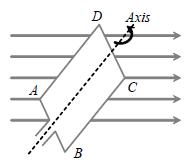
A rectangular coil ABCD is rotated anticlockwise with a uniform angular velocity about the axis
shown in diagram below. The axis of rotation of the coil as well as the magnetic field B are
horizontal. The induced e.m.f. in the coil would be maximum when
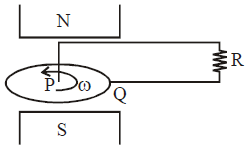
A metal disc rotates freely, between the poles of a magnet in the direction indicated. Brushes P and Q make contact with the edge of the disc and the metal axle.What current, if any, flows through R?
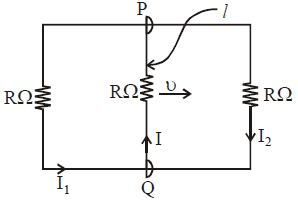
A rectangular loop has a sliding connector PQ of length l and resistance RΩ and it is moving with a speed v as shown. The set-up is placed in a uniform magnetic field going into the plane of the paper. The three currents I1, I2 and I are
Two coaxial solenoids are made by winding thin insulated wire over a pipe of cross-sectional area A = 10 cm² and length = 20 cm. If one of the solenoids has 300 turns and the other 400 turns, their mutual inductance is
\[\left( \mu=4\pi\times 10^{-7} T m A^{-1}\right)\] :
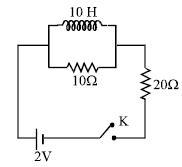
Two resistors of 10 W and 20 W and an ideal inductor of 10 H are connected to a 2 V battery
as shown. The key K is inserted at time t = 0. The initial (t = 0) and final (t →∞) currents
through battery are
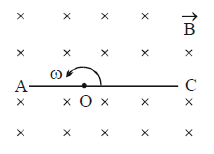
A conducting rod AC of length 4l is rotated about a point O in a uniform magnetic field \[\overrightarrow{B}\] directed into the paper. AO = l and OC = 3l. Then
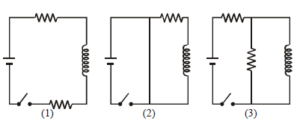
The figure shows three circuits with identical batteries, inductors, and resistors. Rank the circuits according to the current through the battery (i) just after the switch is closed and (ii) a long time later, greatest first :
(i) Just after the switch is closed (t = 0): An inductor opposes any sudden change in current. Initially, it acts like an infinite resistance (open circuit). No current can flow through any branch containing the inductor at this instant.
(ii) A long time later (t =infinity): Once the current reaches a steady state, the inductor no longer opposes the flow. It acts like an ideal wire (short circuit) with zero resistance. You can then rank the circuits by calculating the total equivalent resistance of the remaining resistors.