Electric Potential: Practice Problem & Solution
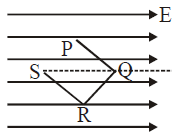
Point charge (q) moves from point (P) to point (S) along the path PQRS as shown in fig. in a uniform electric field E pointing co parallel to the positive direction of the x-axis. The co-ordinates of the points P,Q,R and S are (a, b, 0), (2a, 0, 0), (a, –b, 0) and (0, 0, 0) respectively. The work done by the field in the above process is given by the expression
Solution Explained:
To solve this problem, we apply the core principles of Electric Potential. Understanding the underlying formula is key to arriving at the correct answer below:
Work done in a conservative field is not dependent on path taken by the object so,
\[ dV= - \overrightarrow{E}.\overrightarrow{dr}\]
\[ V= - E\widehat{i}.(-a\widehat{i}-b\widehat{j})\]
so, Potential difference = -E.a
Work Done= -Q. E.a
Leave a Reply