Coulomb's Law: Practice Problem & Solution
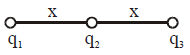
Three charged particles are placed on a straight line as shown in Fig. q1 and q2 are fixed, but q3 can be moved. Under the action of the forces from q1 and q2, q3 is in equilibrium. What is the relation between q1 and q2 ?
Short Solution (Best for NEET):
To solve this problem, we apply the core principles of Coulomb's Law. Understanding the underlying formula is key to arriving at the correct answer below:
To find the relation between \( q_1 \) and \( q_2 \) for \( q_3 \) to be in equilibrium, let's analyze the forces on \( q_3 \).
1. Forces on \( q_3 \):
- The force due to \( q_1 \) on \( q_3 \) is:
\[
F_{13} = \frac{k |q_1| |q_3|}{(2x)^2} = \frac{k |q_1| |q_3|}{4x^2}
\]
(directed towards \( q_1 \) if \( q_1 \) and \( q_3 \) have opposite signs).
- The force due to \( q_2 \) on \( q_3 \) is:
\[
F_{23} = \frac{k |q_2| |q_3|}{x^2}
\]
(directed towards \( q_2 \) if \( q_2 \) and \( q_3 \) have opposite signs).
2. Equilibrium Condition for \( q_3 \):
For \( q_3 \) to be in equilibrium, these forces must be equal in magnitude:
\[
F_{13} = F_{23}
\]
Substituting the values:
\[
\frac{k |q_1| |q_3|}{4x^2} = \frac{k |q_2| |q_3|}{x^2}
\]
Cancelling \( k \), \( |q_3| \), and \( x^2 \) from both sides, we get:
\[
\frac{|q_1|}{4} = |q_2|
\]
Therefore:
\[
q_1 = -4q_2
\]
Answer:
The relation between \( q_1 \) and \( q_2 \) is:
\[
q_1 = -4q_2
\]
Leave a Reply