Parallel Plate Capacitor: Practice Problem & Solution
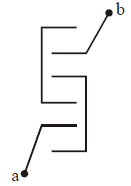
Plates of area A are arranged as shown. The distance between each plate is d, the net capacitance is :
Short Solution (Best for NEET):
To solve this problem, we apply the core principles of Parallel Plate Capacitor. Understanding the underlying formula is key to arriving at the correct answer below:
The arrangement appears to be a system of parallel plates connected alternately to terminals
and
. Let’s determine the net capacitance.
Key Observations:
- The plates form a series-parallel combination.
- The area of each plate is
, and the separation between adjacent plates is
.
- The effective configuration can be reduced to find the equivalent capacitance.
Equivalent Capacitance Derivation:
- Pairing of Plates:
- Adjacent plates (connected alternately) act as capacitors.
- Each capacitor has a capacitance
.
- Parallel and Series Combination:
- There are three capacitors in the arrangement, effectively forming a single network.
- The middle plate shares equal charge with both sides, simplifying to an equivalent capacitance of
.
Thus, the net capacitance is:
Leave a Reply