P-N Junction Diode and its applications - NEET Physics Questions
← Back to Semiconductor Physics

P-N Junction Diode and its applications

Question 11: moderate

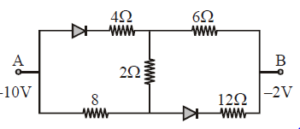
In the following circuit the equivalent resistance between A and B is
1. 20/3 Ω
2. 10 Ω
3. 16 Ω
4. 20 Ω
View Answer

Both the diodes are reversed biased so can be replaced by open circuit.

Req= 8+2+6= 16 ohm
Question 12: moderate

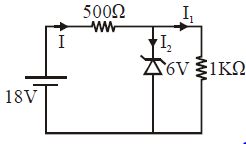
If break down voltage of zener diode is 6 V then value of I2 will be :


1. 18 mA
2. 24 mA
3. 6 mA
4. Zero
View Answer

Voltage across 500 ohm resistor = 12 Volt

I = 12/500 = 24 mA

I 1 =  6/1000= 6mA

I2= I - I1= (24-6 )mA= 18 mA

Question 13: moderate

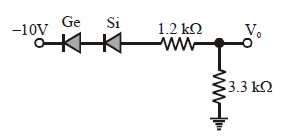
Determine V0 for the network

1. 6.6 V
2. 9 V
3. -9 V
4. -6.6 V
View Answer

Both the diodes are forward biased so current will flow through the circuit

i= 10/4.5= 20/9 mA

V0= i R= (20/9)×3.3 Volt= 6.6 volt

Question 14: easy

When a PN junction diode is reverse biased :

1. Electrons and holes are attracted towards each other and move towards the depletion region
2. Electrons and holes move away from the junction depletion region
3. Height of the potential barrier decreases
4. No change in the current takes place
View Answer

Factual Question: When a PN junction diode is reverse biased potential barrier of depletion increases. Thus Electrons and holes move away from the junction depletion region.

Question 15: moderate

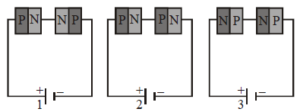
Two PN-junctions can be connected in series by three different methods as shown in the figure. If the potential difference in the junctions is the same, then the correct connections will be :

1. In the circuit (1) and (2)
2. In the circuit (2) and (3)
3. In the circuit (1) and (3)
4. Only in the circuit (1)
View Answer

In circuit 1. First Diode is forward biased and second diode is reverse biased. So, potential across 1st diode is less than 2nd diode.

In circuit 2: Both the diodes are forward biased so potential difference across them is equal

In circuit 3: Both the diodes are reverse biased so potential difference across them is equal to V/2.

Question 16: easy

The dominant mechanism for motion of charge carriers in forward and reverse biased silicon P-N junction are :

1. Drift in forward bias, diffusion in reverse bias
2. Diffusion in forward bias, drift in reverse bias
3. Diffusion in both forward and reverse bias
4. Drift in both forward and reverse bias
View Answer

Theory: In forward biased mode diffusion current is more than drift current. Where as in reverse biased mode diffusion current decreased and become less than drift current.

Question 17: easy

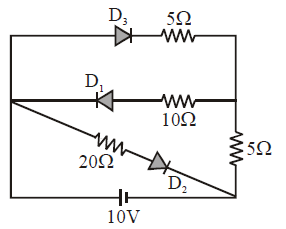
In the given circuit

The current through the battery is :

1. 0.5 A
2. 1 A
3. 1.5 A
4. 2 A
View Answer

Diode D2 and D3 are forward biased. Where as Diode D1 is reversed biased. No current will flow through D1. 

Equivalent Resistance= 20/3 ohm

Current = Voltage / Resistance = 10/ (20/3) = 1.5 Ampere

Question 18: easy

Phodiode, zenerdiode and solar cell is used in:

1. Forward Bias, Reverse Bias, Forward Bias
2. Reverse Bias, Reverse Bias, Unbiased
3. Reverse Bias, UnBias, Reverse Bias
4. Reverse Bias, Reverse Bias, Reverse Bias
View Answer

A Photodiode and Zener Diode operate in Reverse Bias, while a Solar Cell operates in an Unbiased condition (zero external voltage).

  • Photodiode: Works in reverse bias to detect light.
  • Zener Diode: Operates in reverse bias for voltage regulation.
  • Solar Cell: Generates power in an unbiased condition when exposed to light.
Question 19: easy

Which of the following statement is not correct when a junction diode is in forward bias :

1. The width of depletion region decrease
2. Free electrons on n-side will move towards the junction
3. Holes on p-side move towards the junction
4. Electrons on n-side and holes on p-side will move away from junction
View Answer

In forward bias, the applied field opposes the barrier field, pushing major carriers (electrons on n-side and holes on p-side) towards the junction, thereby decreasing the depletion width. Thus, statement (4) is incorrect.

Question 20: easy

The approximate ratio of resistances in the forward and reverse bias of the PN-junction diode is :

1. \(10^2 : 1\)
2. \(10^{-2} : 1\)
3. \(1 : 10^{-4}\)
4. \(1 : 10^4\)
View Answer

Forward resistance of a diode is very small (\(approx 10\Omega\)), while its reverse resistance is extremely high (\(approx 10^5 \Omega\)). The ratio \(R_f / R_r\) is of the order of \(10^{-4}\), which corresponds to \(1 : 10^4\).