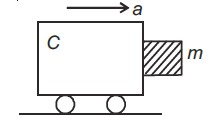
A block of mass m is in contact with the cart. The coefficient of static friction between the block and the cart is ü. The acceleration a of the cart that prevent the block from falling will be
1. a> (mg/ü)
2. a> (g/ü.m)
3. a ≥ (g/ü)
4. a ≤ (g/ü)
View Answer
The condition to prevent the block from falling is that the friction force must be at least equal to the weight of the block:
Since static friction is given by and the normal force is due to pseudo force , we get:
Dividing both sides by :
Thus, the required acceleration of the cart is .
A truck is stationary and has a bob suspended by a light string, in a frame attached to the truck. The truck suddenly moves to the right with an acceleration of a. The pendulum will tilt
1. To the left and angle of inclination of the pendulum with the vertical is tan-¹(g/a)
2. To the left and angle of inclination of the pendulum with the vertical is sin-¹(g/a)
3. To the left and angle of inclination of the pendulum with the vertical is tan-¹(a/g)
4. To the left and angle of inclination of the pendulum with the vertical is sin-¹(a/g)
View Answer
When the truck accelerates to the right with , a pseudo force acts to the left on the bob in the truck's frame. The bob reaches equilibrium where the tension components balance forces:
Thus, the pendulum tilts to the left at an angle with the vertical.
Assertion (A): A reference frame attached to the earth is an inertial frame of reference.
Reason (R): In practical, Newton’s laws can be applied in a frame of reference. Which is attached to the earth.
1. (1) Both (A) & (R) are true and the (R) is the correct explanation of the (A)
2. (2) Both (A) & (R) are true but the (R) is not the correct explanation of the (A)
3. (3) (A) is true but (R) is false
4. (4) Both (A) and (R) are false
View Answer
Assertion (A) is false. The Earth rotates and revolves, making a frame attached to it non-inertial. Reason (R) is false. Newton's laws in their original form are only valid in inertial frames. For a frame attached to the Earth, pseudo forces must be introduced to apply Newton's laws. Thus, both the Assertion and the Reason are false.
Assertion (A): An observer confined to a windowless box cannot tell by any experiment whether he is stationary or in uniform motion with constant velocity w.r.t. the fixed stars.
Reason (R): The basic laws of Physics are identical in all reference systems that move with uniform velocity w.r.t. one another.
1. (1) Both (A) & (R) are true and the (R) is the correct explanation of the (A)
2. (2) Both (A) & (R) are true but the (R) is not the correct explanation of the (A)
3. (3) (A) is true but (R) is false
4. (4) Both (A) and (R) are false
View Answer
Assertion (A) is true. This is a fundamental statement of the Galilean principle of relativity. Reason (R) is true. The laws of physics are invariant in all inertial frames of reference. (R) correctly explains (A) because if physical laws are identical in all inertial frames, no internal experiment can distinguish between them.
Assertion (A): For an upward moving elevator (Lift), pseudo force on a block may be downward.
Reason (R): Pseudo force is the force applied by lift on block in opposite direction of motion.
1. (1) Both (A) & (R) are true and the (R) is the correct explanation of the (A)
2. (2) Both (A) & (R) are true but the (R) is not the correct explanation of the (A)
3. (3) (A) is true but (R) is false
4. (4) Both (A) and (R) are false
View Answer
Assertion (A) is true: When an elevator accelerates upwards with acceleration \(a\), the pseudo force on an object inside is \(ma\) downwards (in the non-inertial frame). So, for upward accelerating elevator, pseudo force on a block is downward.nReason (R) is false: Pseudo force is not a real force applied by the lift; it is an inertial force experienced in a non-inertial reference frame, acting opposite to the acceleration of the frame, not necessarily the direction of motion. Therefore, (A) is true but (R) is false.
A moongphaliwala sells his moongphali using a weighing machine in an elevator.
Assertion (A): He gains more profit if the elevator is accelerating up.
Reason (R): The apparent weight of an object increases in an elevator while accelerating upward.
1. (1) Both (A) & (R) are true and the (R) is the correct explanation of the (A)
2. (2) Both (A) & (R) are true but the (R) is not the correct explanation of the (A)
3. (3) (A) is true but (R) is false
4. (4) Both (A) and (R) are false
View Answer
Assertion (A) is true: If the elevator accelerates upwards, the apparent weight \(N = m(g+a)\) of the peanuts increases. If the moongphaliwala sells by the apparent weight reading (e.g., "1 kg" on the scale), they would be selling a *smaller actual mass* \(m_text{actual} = N/(g+a)\) for the same indicated weight. Thus, they gain more profit.
Reason (R) is true: When an elevator accelerates upwards, the normal force (apparent weight) on an object of mass \(m\) is \(N = m(g+a)\), which is greater than its actual weight \(mg\). Reason (R) correctly explains why the apparent weight increases, leading to the profit gain described in (A).
Assertion (A): A particle on earth found to be at rest when seen from a frame \(U_1\) and moving with a constant velocity when seen from another frame \(U_2\). Then both frames may be non-inertial.
Reason (R): A reference frame attached to the earth must be an inertial frame.
1. Both (A) & (R) are true and the (R) is the correct explanation of the (A)
2. Both (A) & (R) are true but the (R) is not the correct explanation of the (A)
3. (A) is true but (R) is false
4. Both (A) and (R) are false
View Answer
Assertion (A) is true. Earth is a non-inertial frame, so frames observing a particle on Earth can also be non-inertial. Reason (R) is false because a frame attached to Earth is technically non-inertial due to Earth's rotation and orbital motion.
Assertion (A): If pseudo force on a body is assumed as action then frictional force may be reaction for this action.
Reason (R): Action-reaction must acts on different bodies.
1. Both (A) & (R) are true and the (R) is the correct explanation of the (A)
2. Both (A) & (R) are true but the (R) is not the correct explanation of the (A)
3. (A) is true but (R) is false
4. Both (A) and (R) are false
View Answer
Assertion (A) is false. Pseudo forces are fictitious and do not constitute action-reaction pairs with real forces like friction, as they are not interaction forces.
Reason (R) is true. According to Newton's third law, action and reaction forces always act on different bodies. Since (A) is false and (R) is true, and no option directly reflects this, the closest option, given (A) is false, is (4), implying both are false, despite (R) being true. This indicates a potential flaw in the provided options.
Assertion (A): A man standing in a lift which is moving upward, will feel his weight to be greater than when the lift was at rest.
Reason (R): If the acceleration of the lift is ‘a’ upward, then the man of mass m shall feel his weight to be equal to normal reaction (N) exerted by the lift given by \(N = m(g – a)\) (where \(g\) is acceleration due to gravity)
1. (1) Both (A) & (R) are true and the (R) is the correct explanation of the (A)
2. (2) Both (A) & (R) are true but the (R) is not the correct explanation of the (A)
3. (3) (A) is true but (R) is false
4. (4) Both (A) and (R) are false
View Answer
When a lift accelerates upwards, apparent weight is \(N = m(g + a)\), which is greater than \(mg\). So (A) is true. Reason (R) provides the formula for downward acceleration, thus (R) is false.