Linear Momentum and Second Law of Motion - NEET Physics Questions
← Back to Laws of Motion

Linear Momentum and Second Law of Motion

Question 11:

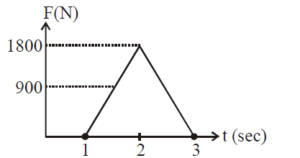
Figure shows an estimated force-time graph for a base ball struck by a bat from this curve determine impulse delivered to the ball.
1. 1800 kg-m/sec
2. 900 kg-m/sec
3. 2700 kg-m/sec
4. None of these
View Answer

Area bounded by force time graph with time axis represents impulse. Area of triangle in the figure is ⇒Impulse = ½×2 ×1800 = 1800 kg m/sec
Question 12:

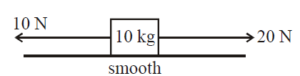
Acceleration of the block is

1. 1 m/sec²
2. 2 m/sec²
3. 3 m/sec²
4. 4 m/sec²
View Answer

Net force acting on the object is 10 N.

so, acceleration a = F/m = 10 N/10 kg= 1 m/s²

Question 13:

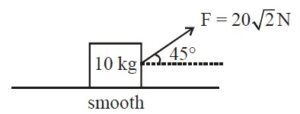
Acceleration of the block is :

1. 1 m/s²
2. 2 m/s²
3. 3 m/s²
4. 4 m/s²
View Answer

Horizontal component of force is F cosθ = 20√2 cos 45° = 20√2 × 1/√2 = 20 N.

So, Horizontal acceleration =  20N / 10kg  = 2m/s²

Question 14:

A hammer of man 1 kg moving with a speed of 6 m/sec strikes a wall and comes to rest in 0.1 sec find average retarding force that stops the hammer :

1. 40 N
2. 50 N
3. 60 N
4. None of these
View Answer

According to Newtons second law of motion, Force is time rate of change in momentum.

So, F = change in momentum / time

F= m (vf-vi)/t= 1 kg (0-6)/0.1= -60 N

Question 15:

A force F = (3ˆi + 4ˆj +12kˆ ) N produces an acceleration of 1 m/sec² in a body, find the mass of the body :

1. 10 kg
2. 13 kg
3. 1 kg
4. 12 kg
View Answer

Given force is F = (3ˆi + 4ˆj +12kˆ ) N , magnitude of force is

⇒F²= (3²+4²+12²) so, F = 13 N

From Newton's second law of motion F= m.a

⇒ 13 N = m.1 so, m=13 kg

Question 16:

A 5 kg block is resting on a frictionless plane, it is struck by a Jet, releasing water at the rate of 4 kg/sec emerging with a speed of 5 m/sec. Calculate the initial acceleration of block :

1. 4 m/sec²
2. 3 m/sec²
3. 5 m/sec²
4. 8 m/sec²
View Answer

Force acting on the object is F = v.(dm/dt)= 5×4 = 20 N

so Acceleration is a= F/m = 20/5 = 4 m/s²

Question 17:

A body of mass 1 kg is acted upon by two perpendicular forces of 8 N and 6 N, find the magnitude of acceleration :

1. 10 m/sec²
2. 6 m/sec²
3. 8 m/sec²
4. 20 m/sec²
View Answer

Resultant force on the object will be F= (8² + 6²)½= 10 N

So, acceleration is a = F/m = 10/1 = 10 m/s²

Question 18:

A small block slides without friction down an inclined plane starting from rest. Let Sn be the distance travelled from time t = n – 1 to t = n. Then Sn/Sn+1 is :

1. 2n-1/2n
2. 2n+1/2n-1
3. 2n-1/2n+1
4. 2n/2n+1
View Answer

Sn = u + a/2(2n-1) = a/2(2n-1)

Sn+1 = u + a/2(2(n+1)-1) = a/2(2n+1)

Sn / Sn+1 = (2n-1)/(2n+1)

Question 19:

Sand is poured on a conveyor belt at the rate of 2 kg/s. If belt is moving horizontally with velocity 4 m/s, then additional force required by engine to keep the belt moving with same constant velocity

1. 8 N
2. 10 N
3. 12 N
4. 14 N
View Answer

The force required to keep the conveyor belt moving at a constant velocity is given by the rate of change of momentum.

Momentum of sand per second:

Force=dPdt=dmdt×v\text{Force} = \frac{\text{dP}}{\text{dt}} = \frac{\text{dm}}{\text{dt}} \times v

Given dmdt=2\frac{dm}{dt} = 2 kg/s and v=4v = 4 m/s,

F=2×4=8 NF = 2 \times 4 = 8 \text{ N}

Thus, the additional force required is 8 N.

Question 20:

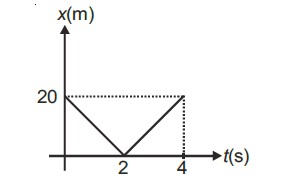
The position-time graph of a particle of mass 2 kg moving along x-axis is as shown in the figure. The magnitude of impulse on the particle at t = 2 s is


1. Zero
2. 10 N-s
3. 20 N-s
4. 40 N-s
View Answer

Solution:

Impulse is given by the change in momentum:

J=Δp=mΔvJ = \Delta p = m \Delta v

From the graph, we find velocity before and after t=2st = 2s:

  • Before t=2st = 2s:

    vinitial=x2x1t2t1=02020=10 m/sv_{\text{initial}} = \frac{x_2 - x_1}{t_2 - t_1} = \frac{0 - 20}{2 - 0} = -10 \text{ m/s}

  • After t=2st = 2s:

    vfinal=x3x2t3t2=20042=10 m/sv_{\text{final}} = \frac{x_3 - x_2}{t_3 - t_2} = \frac{20 - 0}{4 - 2} = 10 \text{ m/s}

Now, impulse:

J=m(vfinalvinitial)

J = m (v_{\text{final}} - v_{\text{initial}}) J=2×(10(10))=2×20=40 NsJ = 2 \times (10 - (-10)) = 2 \times 20 = 40 \text{ Ns}

Final Answer:

40 N-s\mathbf{40 \text{ Ns}}