Linear Momentum and Second Law of Motion - NEET Physics Questions
← Back to Laws of Motion

Linear Momentum and Second Law of Motion

Question 1:

When a constant force is applied to a body, it moves with uniform

1. acceleration
2. velocity
3. speed
4. momentum
View Answer

From Newton's second law of motion, F= m.a

if force is constant acceleration remains constant.

Question 2:

A particle is moving with a constant speed along a straight line path. A force is not required to

1. increase its speed
2. decrease its momentum
3. change the direction
4. keep it moving with uniform velocity
View Answer

As the particle moves with constant speed in straight line its velocity is constant i.e accleration is zero. From Newton's second law of motion

F=m.a

Force required to keep moving with uniform velocity is zero.

Question 3:

The linear momentum of a particle is given by P = a + bt², where t is time and a & b are constants. The force acting on the body is directly proportional to :

1.
2. t
3.
4.
View Answer

Given momentum of the object is P = a + bt²;

Force is defined as rate of change of momentum F= dP/dt= 2bt. so Force is proportional to t.

Question 4:

A body of mass 1 kg moving on a smooth horizontal surface with velocity 5m/s is to be brought to rest in 5 sec. How much force need to be applied :

1. 25N
2. 10N
3. 5N
4. 1N
View Answer

Force is defined as rate of change of momentum ie. F= dP/dt= change in momentum / time

Here Force = (mv-mu)/t= m(v-u)/t= 1 kg (0- 5)/ 5 = 1 N

Question 5:

The momentum of a particle is P = 2cos tˆi + 2sin t ˆj. What is the angle between the force F acting on the particle and the momentum P ?

1. 45°
2. 90°
3. 135°
4. 180°
View Answer

Momentum of object is given as, P = 2cos tˆi + 2sin t ˆj , 

From Newtons Second law, F = dP/dt = -2 sin t î + 2 cos t ˆj.

Taking Dot product of P and F we get = -4 sint . cos t + 4 sint .cost =0 .

So, force and momentum are perpendicular to each other.

Question 6:

A body moving with uniform velocity is stopped in 0.25 sec by applying a force of 200 N. What is the impulse :

1. 5 N-s
2. 25 N-s
3. 50 N-s
4. 100 N-s
View Answer

Impulse is change in momentum so, J = F.dt = 200 × 0.25 =50 N-s

Question 7:

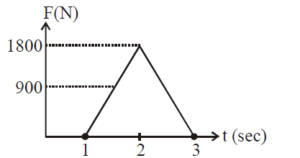
Figure shows an estimated force-time graph for a base ball struck by a bat from this curve determine impulse delivered to the ball.

1. 1800 kg-m/sec
2. 900 kg-m/sec
3. 2700 kg-m/sec
4. None of these
View Answer

Area bounded by force time graph with time axis represents impulse. Area of triangle in the figure is ⇒Impulse = ½×2 ×1800 = 1800 kg m/sec

Question 8:

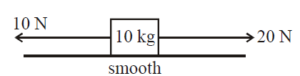
Acceleration of the block is

1. 1 m/sec²
2. 2 m/sec²
3. 3 m/sec²
4. 4 m/sec²
View Answer

Net force acting on the object is 10 N.

so, acceleration a = F/m = 10 N/10 kg= 1 m/s²

Question 9:

A force F = (3ˆi + 4ˆj +12kˆ ) N produces an acceleration of 1 m/sec² in a body, find the mass of the body :

1. 10 kg
2. 13 kg
3. 1 kg
4. 12 kg
View Answer

Given force is F = (3ˆi + 4ˆj +12kˆ ) N , magnitude of force is

⇒F²= (3²+4²+12²) so, F = 13 N

From Newton's second law of motion F= m.a

⇒ 13 N = m.1 so, m=13 kg

Question 10:

Sand is poured on a conveyor belt at the rate of 2 kg/s. If belt is moving horizontally with velocity 4 m/s, then additional force required by engine to keep the belt moving with same constant velocity

1. 8 N
2. 10 N
3. 12 N
4. 14 N
View Answer

The force required to keep the conveyor belt moving at a constant velocity is given by the rate of change of momentum.

Momentum of sand per second:

Force=dPdt=dmdt×v\text{Force} = \frac{\text{dP}}{\text{dt}} = \frac{\text{dm}}{\text{dt}} \times v

Given dmdt=2\frac{dm}{dt} = 2 kg/s and v=4v = 4 m/s,

F=2×4=8 NF = 2 \times 4 = 8 \text{ N}

Thus, the additional force required is 8 N.