Equilibrium based Questions - NEET Physics Questions
← Back to Laws of Motion

Equilibrium based Questions

Question 1: easy

A body of weight  W1 is suspended from the ceiling of a room through a chain of weight W2. The ceiling pulls the chain by a force

1. W1
2. W2
3. (W1+W2)/2
4. W1+W2
View Answer

Total weight of chain + block system is W1 +W2.
Question 2: easy

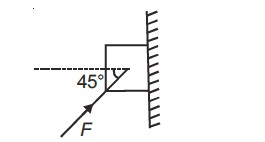
Block A of mass 4 kg is to be kept at rest against a smooth vertical wall by applying a force F as shown in figure. The force required is (g = 10 m/s²)

equilibrium based question in laws of motion neet physics

1. 40√2 N
2. 20√2 N
3. 10√2 N
4. 15√2 N
View Answer

equilibrium based question in laws of motion neet physics

For Equilibrium, F cos ( 45°) = 40

so, F = 40√2 N

Question 3: easy

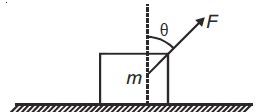
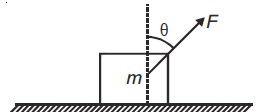
In the given arrangement, the normal force applied by block on the ground is


laws of motion neet physics questions

1. mg
2. mg – Fcosθ
3. mg + Fcosθ
4. Fcosθ
View Answer

For Equilibrium in vertical direction

F cos θ + N = mg

or N = mg - F cosθ

Question 4: easy

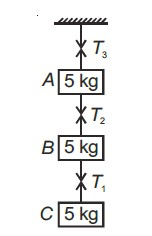
The value of \( \frac{T_{3}}{T_{1}} \) is

\[ \]


1. 1
2. 2
3. 3
4. 3/2
View Answer

As the arrangement is in equilibrium T3= 150 N and T1 = 50 N

so T3/T1=3

Question 5: easy

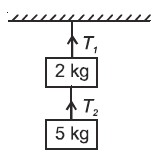
The ratio of tension T1 and T2 is (strings are massless)

1. 7 : 2
2. 7 : 5
3. 5 : 2
4. 2 : 7
View Answer

For Equilibrium Condition,


T1 = 70 N and T2 = 50 N so, T1: T2 = 7 : 5neet equilibrium question

Question 6: easy

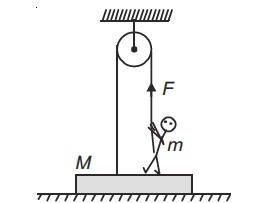
A man of mass m is standing on a board and pulling the board of mass m up with force F by the pulley system as shown. Normal reaction between man and board is


neet question for equilibrium NLM

1. mg – F
2. mg + F
3. (m + M) g + F
4. (m – M)g – F
View Answer

As the person is in equilibrium net force acting on it should be zero,

so, mg = N + F

⇒ N = mg - F

Question 7: easy

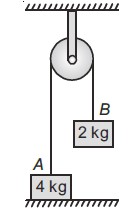
In the arrangement shown, the normal reaction between the block A and ground is:


1. 10 N
2. 20 N
3. 30 N
4. 40 N
View Answer

Weight of block AA = 4×10=404 \times 10 = 40 N.

Weight of block BB = 2×10=202 \times 10 = 20 N.

Tension in the string TT = Weight of BB = 20 N.

Normal reaction on AA, N=N = Weight of AA – Tension TT = 4020=2040 - 20 = 20 N.

Question 8: easy

In translatory equilibrium

1. The net external force acting on particle is zero
2. The net external force acting on particle is constant (non-zero)
3. Particle is always at rest
4. Velocity of particle changes linearly with time
View Answer

In translational equilibrium the net force acting on the object is zero. so the object moves with constant velocity.

Question 9: easy

A body in equilibrium will not have :

1. velocity
2. momentum
3. acceleration
4. All of the above
View Answer

For a body in equilibrium, the net external force acting on it is zero. According to Newton's second law, \(F_{\\text{net}} = ma = 0\), which means the acceleration of the body must be zero.

Question 10: easy

A body is said to be in mechanical equilibrium if

1. The net force on the body is zero
2. The net torque on the body is zero
3. Both net force and net torque on the body is zero
4. The centre of mass of the body is at rest
View Answer

For complete mechanical equilibrium, a body must be in both translational equilibrium (net external force is zero) and rotational equilibrium (net external torque is zero).