Ground to Ground Projectile - NEET Physics Questions
← Back to Kinematics

Ground to Ground Projectile

Question 11:

A projectile of mass 100 g is fired with a velocity of 20 ms–¹ making an angle of 30° with the horizontal. As it rises to the highest point of its path, its momentum changes by (g = 10 ms–²) :

1. 1/2 kg ms–¹
2. 1 kg ms–¹
3. 2 kg ms–¹
4. None of these
View Answer

The momentum change occurs only in the vertical direction as the horizontal component of velocity remains constant throughout the flight.

### Initial vertical component of velocity:
\[
u_y = u \sin \theta = 20 \times \sin 30^\circ = 20 \times \frac{1}{2} = 10 \, \text{m/s}
\]

At the highest point, the vertical component of velocity becomes zero.

### Change in vertical velocity:
\[
\Delta v_y = u_y - 0 = 10 \, \text{m/s}
\]

### Mass of the projectile:
\[
m = 100 \, \text{g} = 0.1 \, \text{kg}
\]

### Change in momentum:
\[
\Delta p = m \times \Delta v_y = 0.1 \times 10 = 1 \, \text{kg m/s}
\]

Thus, the change in momentum is \( 1 \, \text{kg m/s} \).
Question 12:

A body is projected at an angle of 30° with the horizontal and with a speed of 30 ms–¹. What is the angle with the horizontal after 1.5 seconds ? (Take g = 10 ms–²)

1.
2. 30°
3. 60°
4. 90°
View Answer

To find the angle with the horizontal after 1.5 seconds, we calculate the horizontal and vertical components of velocity at that moment.

- Initial speed: \( u = 30 \, \text{m/s} \)
- Angle of projection: \( \theta = 30^\circ \)
- Horizontal component of velocity (remains constant):
\[
u_x = u \cos \theta = 30 \times \frac{\sqrt{3}}{2} = 15\sqrt{3} \, \text{m/s}
\]
- Vertical component of velocity after 1.5 seconds:
\[
u_y = u \sin \theta - g t = 30 \times \frac{1}{2} - 10 \times 1.5 = 15 - 15 = 0 \, \text{m/s}
\]

Since the vertical component is 0, the angle with the horizontal is:

\[
\text{Angle} = 0^\circ
\]

Thus, the angle with the horizontal after 1.5 seconds is \( 0^\circ \).

Question 13:

A projectile is fired from level ground at an angle θ above the horizontal. The elevation angle Φ of the highest point as seen from the launch point is related to θ by the relation :

1. \[tan\phi=\frac{1}{4}tan\theta\]
2. \[tan\phi=tan\theta\]
3. \[tan\phi=\frac{1}{2}tan\theta\]
4. \[tan\phi=2tan\theta\]
View Answer

\[ tan \phi= H/2R= \frac{1}{2}tan\theta \]

Question 14:

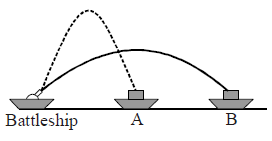
Two guns on a battleship simultaneously fires two shells with same speed at enemy ships. If the shells follow the parabolic trajectories as shown, which ship will get hit first ?


1. A
2. B
3. both at same time
4. need more information
View Answer

As A is having more maximum height it will have more vertical speed uy. So A will take more time than A.

So, ship B will be hit first.

Question 15:

A particle is fired with velocity u making an angle θ with the horizontal. What is the change in velocity when it is at the highest point :

1. u cosθ
2. u
3. u sinθ
4. (u cosθ-u)
View Answer

At the highest point of its trajectory, the vertical component of the velocity becomes zero, while the horizontal component remains unchanged.

- Initial velocity: \( u \)
- Horizontal component: \( u_x = u \cos \theta \)
- Vertical component: \( u_y = u \sin \theta \)

At the highest point:
- Vertical velocity: \( u_y = 0 \)
- Horizontal velocity: \( u_x = u \cos \theta \)

The change in velocity is only in the vertical direction, from \( u \sin \theta \) to 0.

So, the change in velocity is:

\[
\Delta v = u \sin \theta
\]

Thus, the change in velocity is \( u \sin \theta \).