A body of mass m moving along a straight line covers half the distance with a speed of 2 ms–¹. The remaining half of distance is covered in two equal time intervals with a speed of 3 ms–¹ and 5 ms–¹ respectively. The average speed of the particle for the entire journey is
1. 3/8 m-¹
2. 8/3 m-¹
3. 4/3 m-¹
4. 16/3 m-¹
View Answer
For Second Half of Journey
\[ V_{av}=\frac{3+5}{2}= 4 m/s \]
\[ V_{av}= \frac{2\times 2 \times 4}{2+4}= \frac{8}{6}= \frac{4}{3} \]
Velocity-time graph of a particle is given as :
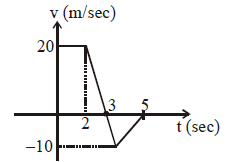
then average speed of particle from t = 0 to t = 5 sec is :
1. 5 m/sec
2. 8 m/sec
3. 10 m/sec
4. 12 m/sec
View Answer
Area bounded with Velocity time graph represents displacement. Magnitude of Area bounded by Velocity time graph represents distance.
Total Area = 60 so, distance = 60 m and time = 5 sec.
Average speed = 12 m/s
A car is moving along a straight line OP as shown in the figure. It moves from O to P in 18 s and returns from P to Q in 6 s. Which of the following statements is not correct regarding the motion of the car :

1. The average speed of the car in going from O to P and come back to Q is 20 ms–¹
2. The average velocity of the car in going from O to P and come back to Q is 10 ms–¹
3. The average speed of the car in going from O to P and come back to O is 20 ms–¹
4. The average velocity of the car in going O to P and come back to O is 20 ms–¹
View Answer
Total Distance = OP + PQ = 360 + 120 = 480 m
Displacement = OQ= 240 m
Average Speed = 480/24 = 20 m/s
Average Velocity= 240/24= 10 m/s
A scooter is going towards east at 10 ms–¹ turns right through an angle of 90°. If the speed of the scooter remains unchanged in taking this turn, the change in the velocity of the scooter is :
1. 20.0 ms–¹ in south–western direction
2. zero
3. 10.0 ms–¹ in southern direction
4. 14.14 ms–¹ in south–western direction
View Answer
Change in a vector when it is rotated by an angle θ is
\[ \Delta V = 2V sin \left( \frac{\theta}{2} \right) \]
\[ \Delta V = 2\times 10 sin \left( \frac{90^{0}}{2} \right)= 20/\sqrt{2}= 10\sqrt{2}= 14.4 m/s \]
Figure shows position versus time graph of two rabbits running opposite to each other between two trees. Which of the following statements are true.
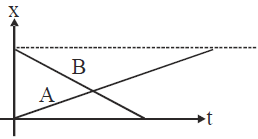
1. Rabbit A has greater magnitude of average velocity.
2. Rabbit B has greater magnitude of average velocity.
3. Both the Rabbits have same displacement.
4. Both the Rabbits have same constant speed.
View Answer
Distance is equal for both A and B. B is taking lesser time to complete so its speed is higher.
A particle covers half of its total distance with speed \( v_1 \) and the rest half distance with speed \( v_2 \). Its average speed during the complete journey is:
[2011 Mains]
1. \( \frac{v_1 v_2}{v_1 + v_2} \)
2. \( \frac{2v_1 v_2}{v_1 + v_2} \)
3. \( \frac{v_1 v_2^2}{v_1 + v_2^2} \)
4. \( \frac{v_1 v_2}{2} \)
View Answer
Concept: Average speed is total distance divided by total time. Let total distance be \( D \). Time for first half: \( t_1 = \frac{D/2}{v_1} \). Time for second half: \( t_2 = \frac{D/2}{v_2} \). Total time \( T = t_1 + t_2 = D \left( \frac{v_1 + v_2}{2v_1 v_2} \right) \). Average speed \( = \frac{D}{T} = \frac{2v_1 v_2}{v_1 + v_2} \).
A car moves from X to Y with a uniform speed \( v_u \) and returns to Y with a uniform speed \( v_d \). The average speed for this round trip is:
(2007)
1. \( \sqrt{v_u v_d} \)
2. \( \frac{v_d v_u}{v_d + v_u} \)
3. \( \frac{v_u + v_d}{2} \)
4. \( \frac{2v_d v_u}{v_d + v_u} \)
View Answer
Concept: Average speed is total distance divided by total time. Let distance from X to Y be \( D \). Time taken to go to Y: \( t_u = D/v_u \). Time taken to return to X: \( t_d = D/v_d \). Total distance \( = 2D \). Total time \( = t_u + t_d = D/v_u + D/v_d = D \frac{v_u + v_d}{v_u v_d} \). Average speed \( = \frac{2D}{D \frac{v_u + v_d}{v_u v_d}} = \frac{2v_u v_d}{v_u + v_d} \).
A particle is moving such that its position coordinates (x, y) are: \((2\text{ m}, 3\text{ m})\text{ at time } t = 0,\) \((6\text{ m}, 7\text{ m})\text{ at time } t = 2\text{ s}\) and \((13\text{ m}, 14\text{ m})\text{ at time } t = 5\text{ s}\). Average velocity \((\vec{V}_{av})\text{ from } t = 0\text { to } t = 5\text{ s}\) is:
(2014)
1. \(\frac{1}{5}(13\hat{i}+14\hat{j})\)
2. \(\frac{7}{3}(\hat{i}+\hat{j})\)
3. \(2(\hat{i}+\hat{j})\)
4. \(\frac{11}{5}(\hat{i}+\hat{j})\)
View Answer
Average velocity is \(\vec{V}_{av} = \frac{\Delta \vec{r}}{\Delta t} = \frac{\vec{r}_f - \vec{r}_i}{t_f - t_i}\). Initial position at \(t_i = 0\text{ s}\) is \(\vec{r}_i = 2\hat{i} + 3\hat{j}\). Final position at \(t_f = 5\text{ s}\) is \(\vec{r}_f = 13\hat{i} + 14\hat{j}\). So, \(vec{V}_{av} = \frac{(13\hat{i} + 14\hat{j}) - (2\hat{i} + 3\hat{j})}{5 - 0} = \frac{11\hat{i} + 11\hat{j}}{5} = \frac{11}{5}(\hat{i} + \hat{j})\) m/s.