Planet and Satellite - NEET Physics Questions
← Back to Gravitation

Planet and Satellite

Question 11: easy

A force F is given by F = at + bt², where t is time. The dimensions of a and b are

1. [M L T–³] and [M L T–4]
2. [M L T–4] and [M L T–³]
3. [M L T–¹] and [M L T–²]
4. [M L T–²] and [M L T0]
View Answer

The force \( F = at + bt^2 \) has dimensions of force \([M L T^{-2}]\).

For \( at \), the dimensions of \( a \) must be:

\[
[M L T^{-2}] = [a][T]
\]

Thus, the dimensions of \( a \) are:

\[
a = [M L T^{-3}]
\]

For \( bt^2 \), the dimensions of \( b \) must be:

\[
[M L T^{-2}] = [b][T^2]
\]

Thus, the dimensions of \( b \) are:

\[
b = [M L T^{-4}]
\]

So, the dimensions are:
- \( a = [M L T^{-3}] \)
- \( b = [M L T^{-4}] \)
Question 12: difficult

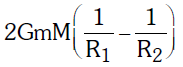
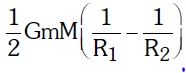
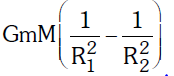
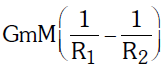
The additional kinetic energy to be provided to a satellite of mass m revolving around a planet of mass M, to transfer it from a circular orbit of radius R1 to another of radius R2(R2 > R1) is :

1.
2.
3.
4.
View Answer

The additional kinetic energy required to transfer a satellite from a circular orbit of radius \( R_1 \) to \( R_2 \) is the difference in kinetic energy between the two orbits.

Kinetic energy in a circular orbit is:

\[
K = \frac{GMm}{2R}
\]

The kinetic energy difference is:

\[
\Delta K = \frac{GMm}{2R_1} - \frac{GMm}{2R_2}
\]

Simplifying:

\[
\Delta K = \frac{GMm}{2} \left( \frac{1}{R_1} - \frac{1}{R_2} \right)
\]

So, the additional kinetic energy is:

\[
\Delta K = \frac{GMm}{2} \left( \frac{1}{R_1} - \frac{1}{R_2} \right)
\]