The pressure and temperature of two different gases is P and T having the volume V for each. They are mixed keeping the same volume and temperature, the pressure of the mixture will be :
Since the gases are mixed at constant volume \( V \) and temperature \( T \), we can apply the ideal gas law for each gas:
For each gas, we have:
\[
P = \frac{nRT}{V}
\]
Since both gases have the same pressure \( P \), volume \( V \), and temperature \( T \), they contribute equally to the total pressure when mixed.
After mixing, the total pressure of the mixture is the sum of the partial pressures of each gas:
\[
P_{\text{total}} = P + P = 2P
\]
During an experiment, an ideal gas is found to obey an additional law VP² = constant. The gas is initially at a temperature T and volume V. When it expands to a volume 2V, its temperature will be :
Given that the gas obeys the law \( VP^2 = \text{constant} \).
1. Initially:
\[
VP^2 = k
\]
2. When the volume changes from \( V \) to \( 2V \):
\[
(2V)P'^2 = k
\]
where \( P' \) is the new pressure.
Since \( VP^2 = (2V)P'^2 \), we can relate the pressures as:
\[
P'^2 = \frac{P^2}{2}
\]
\[
P' = \frac{P}{\sqrt{2}}
\]
3. Use the ideal gas law initially and finally:
\[
PV = nRT
\]
\[
P' \cdot 2V = nRT'
\]
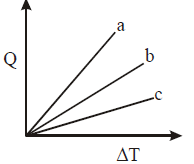
Figure shows the variation in temperature (ΔT) with the amount of heat supplied (Q) in an isobaric process corresponding to a monoatomic (M), diatomic (D) and a polyatomic (P) gas. The initial state of all the gases are the same and the scales for the two axes coincide. Ignoring vibrational degrees of freedom, the lines a, b and c respectively correspond to :
To determine which line corresponds to each type of gas (monoatomic, diatomic, polyatomic), we can use the fact that the specific heat at constant pressure \( C_p \) varies with the degrees of freedom of each gas. Since \( Q = n C_p \Delta T \), for a given \( Q \), the slope of the \( Q \)-\( \Delta T \) line is inversely proportional to \( C_p \).
1. Monoatomic gas (M): \( C_p = \frac{5}{2} R \).
2. Diatomic gas (D): \( C_p = \frac{7}{2} R \).
3. Polyatomic gas (P): \( C_p \) is higher than both monoatomic and diatomic due to additional rotational degrees of freedom.
Since the slope is inversely related to \( C_p \):
- Line with the lowest slope (shallowest) corresponds to the monoatomic gas (M).
- Line with a medium slope corresponds to the diatomic gas (D).
- Line with the steepest slope corresponds to the polyatomic gas (P).
Thus, lines a, b, and c correspond to P, D, and M, respectively.
The following sets of values for Cv and Cp of a gas have been reported by different students. The units are cal/mole-K. Which of these sets is most reliable ?
For an ideal gas, the relationship between \( C_p \) and \( C_v \) is:
\[
C_p - C_v = R
\]
where \( R \approx 2 \, \text{cal/mole-K} \).
Check each option:
1. If \( C_v = 3 \) and \( C_p = 5 \):
\[
C_p - C_v = 5 - 3 = 2 = R
\]
This matches the expected result.
2. Other sets will not satisfy \( C_p - C_v = 2 \) as accurately.
Thus, \( C_v = 3 \) and \( C_p = 5 \) is the most reliable set.
According to kinetic theory of gases : (A) Collisions are always elastic (B) There is no force of attraction among the molecules (C) Only a small number of molecules have very high velocity (D) Between collisions, the molecules move in straight lines with constant velocities
According to the kinetic theory of gases:
- (A) Collisions are always elastic: Gas molecule collisions do not lose kinetic energy, so they are elastic.
- (B) There is no force of attraction among the molecules: Assumption of ideal gases is no intermolecular forces.
- (C) Only a small number of molecules have very high velocity: Most molecules have moderate speeds; only a few have very high speeds.
- (D) Between collisions, the molecules move in straight lines with constant velocities: Molecules move with constant speed in straight lines until they collide.
All options are correct as per the assumptions of kinetic theory.
Which of the following gases possesses maximum rms velocity, all being at the same temperature?
The root mean square (rms) velocity of a gas is given by:
\[
v_{\text{rms}} = \sqrt{\frac{3RT}{M}}
\]
where \( M \) is the molar mass. Since all gases are at the same temperature, the gas with the smallest molar mass will have the highest \( v_{\text{rms}} \).
Hydrogen has the smallest molar mass among the options, so it has the maximum rms velocity.
A liquid cools down from 70°C to 60°C in 5 minutes. The time taken to cool it from 60°C to 50°C will be
According to Newton's law of cooling, the rate of cooling is proportional to the temperature difference between the object and its surroundings. As the liquid cools, the temperature difference between the liquid and the surroundings decreases, which slows down the rate of cooling.
Therefore, it will take greater than 5 minutes to cool from 60°C to 50°C, as the temperature difference is smaller, resulting in a slower cooling rate.