Modern Physics - NEET Physics Chapterwise MCQs & PYQs
Rankers Physics
One Stop for Your NEET Physics Preparation
NEET Modern Physics MCQs & PYQs
Practice NEET Modern Physics Questions
Question 21:
moderate
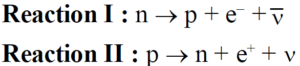
Consider the following nuclear reactions and select the correct statements from the options that follow. (A) Free neutron has higher mass than proton, therefore reaction I is possible (B) Free proton has less mass than neutron, therefore reaction II is not possible for the free proton (C) Inside a nucleus, both decays (reaction I and II) are possible (D) Inside a nucleus, reaction I is not possible but reaction II is possible.
Ultraviolet light of wavelength 300 nm and intensity 1.0 watt/m² falls on the surface of a photosensitive material. If 1% of the incident photons produce photoelectrons, then the number of photoelectrons emitted from an area of 1.0 cm² of the surface is nearly
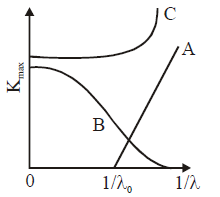
Photoelectric emission is observed from a metallic surface for frequencies ν1 and ν2 of the incident light rays (ν1 > ν2). If the maximum value of kinetic energy of the photoelectrons emitted in the two cases are in the ratio of 1 : k, then the threshold frequency of the metallic surface is :
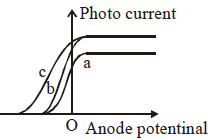
The figure shows the variation of photo current with anode potential for a photo-sensitive surface for three different radiations. Let Ia, Ib, and Ic be the intensities and fa, fb and fc be the frequencies for the curves a, b and c respectively :