Modern Physics - NEET Physics Chapterwise MCQs & PYQs
Rankers Physics
One Stop for Your NEET Physics Preparation
NEET Modern Physics MCQs & PYQs
Practice NEET Modern Physics Questions
Question 11:
difficult
When photons of energy hv fall on an aluminium plate (of work function E0), photoelectrons of maximum kinetic energy K are ejected. If the frequency of the radiation is doubled, the maximum kinetic energy of the ejected photoelectrons will be :
When a point source of monochromatic light is at a distance of 0.2 m from a photoelectric cell, the cut-off voltage and the saturation current are 0.6 volt and 18 mA respectively. If the same source is placed 0.6 m away from the photoelectric cell, then :
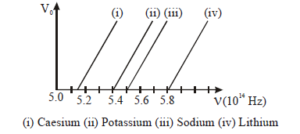
The figure shows different graphs between stopping potential (V0) and frequency (n) for photosensitive surface of caesium, potassium, sodium and lithium. The plots are parallel. Correct ranking of the targets according to their work function, greatest first, will be :
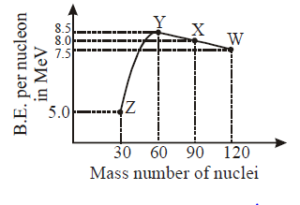
Binding energy per nucleon verses mass number curve for nuclei is shown in the figure. W, X, Y and Z are four nuclei indicated on the curve. The process that would release energy is :
The velocity of the most energetic electrons emitted from a metallic surface is doubled when the frequency v of the incident radiation is doubled. The work function of this metal is :
Energy from the sun is received on the earth at the rate of 2 cal per cm² per min. If average wavelength of solar light be taken at 5500 Å, then how many photons are received on the earth per cm² per min ?
Monochromatic light of frequency f1 is incident on a photocell and the stopping potential is found to be V1. What is the new stopping potential of the cell if it is radiated by monochromatic light of frequency f2 ?