Question 61:
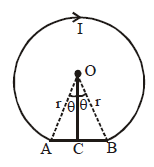
moderateA wire is bent in the form of a circular arc with a straight portion AB. Magnetic induction at O
when current I is flowing in the wire, is :
Question 61:
moderateA wire is bent in the form of a circular arc with a straight portion AB. Magnetic induction at O
when current I is flowing in the wire, is :
Question 62:
moderateSix wires of current I1 = 1A, I2 = 2A, I3 = 3A, I4 = 1A, I5 = 4A, I6 = 5A cut the page perpendicular at points 1,2,3,4,5 and 6. The value of time integral of \(\overrightarrow{B}\) around the dotted closed path \(\left( i.e, \oint_{}^{}\overrightarrow{B} \overrightarrow{dl} \right)\) is :
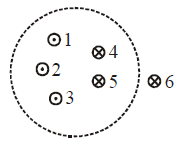
current enclosed is (1+2+3-1-4)= 1A
using ampere circuital law we get the answer.
Question 63:
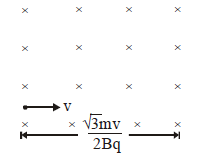
difficultA charged particle of mass m, charge q is moving with speed v. It enters a uniform magnetic field acting perpendicular to the plane of paper inwards as shown in Fig. The width of the
magnetic field is √3 mv/2qB . Then time taken by charged particle to emerge from the magnetic
field is :
Question 64:
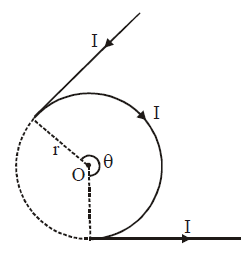
moderateA wire carrying current I has the configuration as shown in Fig. Two semi-infinite straight
sections both tangent to the same circle are connected by a circular arc of central angle θ,
along the circumference of the circle, with all sections lying in the same plane. If the magnetic
field at the centre of the circle is zero, then θ is:
Question 65:
difficultA hallow cylindrical wire carries current I, having inner & outer radius R & 2R respectively. Magnetic field at a point which is 5R/4 distance away from the wire :
To solve for the magnetic field at a distance of
from the axis of a hollow cylindrical wire carrying current
, with inner radius
and outer radius
, we use Ampère's Law. The key steps are:
For
(points within the shell of the cylinder):
is uniform, given by:
(where
) is:
Substituting
:
Since
lies within the shell (
), substitute
into the above equation:
Simplify:
,
.
Thus:
Simplify further:
Final simplification:
Question 66:
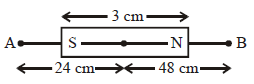
moderateIn the given diagram, ratio of magnetic field at point A and B will be :
Question 67:
moderate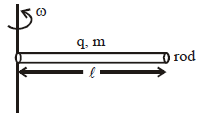
In the given diagram a rod is rotating with angular velocity ω. Mass of this rod is m, charge q, and length is l then find out magnetic moment of this rod :
Question 68:
moderate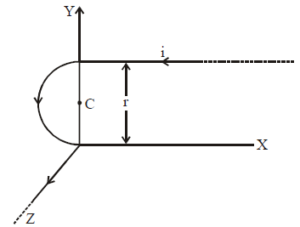
In the above figure magnetic field at point C will be:
Question 69:
easyAn eΘ is moving in North direction & magnetic field at this place is along upward direction then
eΘ will be deviate towards :
Question 70:
moderateA proton is moving along y-axis with velocity 200 m/s & magnetic field of magnitude 1 μT is acting at 30° angle to the y-axis. Then radius of circle in its helical path will be :