Question 11:
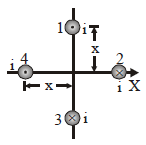
difficultWhat will be the resultant magnetic field at origin due to four infinite length wires. If each wire produces magnetic field ‘B’ at origin:
Question 11:
difficultWhat will be the resultant magnetic field at origin due to four infinite length wires. If each wire produces magnetic field ‘B’ at origin:
Question 12:
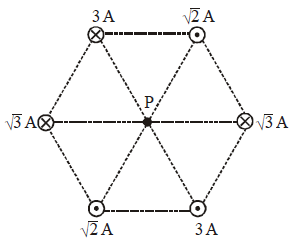
moderateConsider a set of six infinite long straight parallel wires arranged perpendicular to the plane of paper in a hexagon as shown. The length of the each side of the hexagon is 3 cm. What is the magnitude and direction of the magnetic field at point P ?
Question 13:
moderateGiven below are two statements
Statement I : Biot-Savart’s law gives us the expression for the magnetic field strength of an infinitesimal current element ($I d \vec{l}$) of the current carrying conductor only.
Statement II : Biot-Savart’s law is analogous to Coulomb’s inverse square law of charge $q$, with the former being related to the field produced by a scalar source, $Id \vec{l}$, while the latter being produced by a vector source, $q$.
In light of above statements choose the most appropriate answer from the options given below
Statement I is correct as Biot-Savart's law defines the magnetic field for a current element $I d \vec{l}$. Statement II is incorrect because $I d \vec{l}$ is a vector source while charge $q$ is a scalar source, reversing the description.
Question 14:
moderateA long straight wire of radius $a$ carries a steady current $I$. The current is uniformly distributed over its cross-section. The ratio of the magnetic fields $B$ and $B’$ at radial distances $\frac{a}{2}$ and $2a$ respectively, from the axis of the wire is:
(2016-1)
The magnetic field inside the wire at distance $r = a/2$ is given by $B = \frac{\mu_0 I r}{2\pi a^2}$. The magnetic field outside at $r' = 2a$ is $B' = \frac{\mu_0 I}{2\pi r'}$. Evaluating both gives equal magnitudes, so the ratio $B / B'$ is equal to $1$.