Question 1:
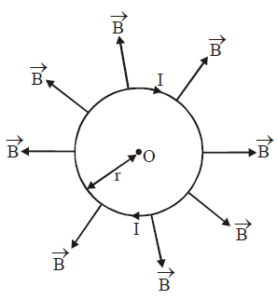
easyA ring of radius r is carrying a current I. The magnetic field B is always perpendicular to the ring as shown in Fig. The force on the ring is :
Question 1:
easyA ring of radius r is carrying a current I. The magnetic field B is always perpendicular to the ring as shown in Fig. The force on the ring is :
Question 2:
easyAssertion (A): Two long parallel conductors carrying currents in the same direction experience a force of attraction.
Reason (R): The magnetic fields produced in the space between two long parallel current carrying conductors (by each of these conductors) are in the same direction.
Parallel currents in the same direction attract, so (A) is true. For two parallel currents in the same direction, the magnetic fields in the space between them are in opposite directions (e.g., one into the page, one out of the page by Right Hand Rule). Therefore, (R) is false.
Question 3:
easyAssertion (A): A system can not have magnetic moment when its net charge is zero.
Reason (R): Magnetic field arises due to charge in motion.
Assertion (A) is false. A current loop, for instance, has zero net charge but possesses a magnetic moment. Reason (R) is true; magnetic fields are indeed generated by moving charges (currents). Since Assertion (A) is false, options A, B, and C are incorrect. Option D states both (A) and (R) are false, which is partially incorrect as (R) is true. However, being the only option where (A) is stated as false, we choose it.
Question 4:
easyAssertion (A): The magnetic field induction due to an infinite long current carrying solid cylindrical conductor of radius \(R\), at a distance \(R/2\) and \(2R\) from its axis is same.
Reason (R): An infinite long current carrying solid cylindrical conductor is a source of uniform magnetic field.
Assertion (A) is true: Using Ampere's Law, \(B(R/2) = \frac{\mu_0 I (R/2)}{2\pi R^2} = \frac{\mu_0 I}{4\pi R}\) and \(B(2R) = \frac{\mu_0 I}{2\pi (2R)} = \frac{\mu_0 I}{4\pi R}\).
Reason (R) is false: The magnetic field is not uniform; it varies linearly inside (\(B \propto r\)) and inversely outside (\(B \propto 1/r\)). Thus, A is true and R is false.
Question 5:
easyAssertion (A): If a uniform current carrying loop is placed in uniform magnetic field perpendicular to plane of loop. Tension or compression is created in loop.
Reason (R): Net force on any closed loop in uniform magnetic field is zero.
Assertion (A) is true: Magnetic forces \(I d\vec{l} \times \vec{B}\) on segments act radially, causing tension or compression. Reason (R) is true: For a uniform \(\vec{B}\), \(\vec{F}_{net} = I \oint d\vec{l} \times \vec{B} = 0\). However, zero net translational force does not explain the internal tension/compression. Both are true, but (R) is not the explanation for (A).
Question 6:
easyTesla is the unit of
(1997, 88)
The SI unit of magnetic field (magnetic induction) is Tesla ($ \text{T} $), defined as one Weber per square meter ($ \text{Wb/m}^2 $).
Question 7:
easyThe magnetic field at a distance r from a long wire carrying current i is 0.4 tesla. The magnetic field at a distance 2r is
(1992)
Magnetic field due to a long straight wire is inversely proportional to distance ($B \propto 1/r$). When distance is doubled from $r$ to $2r$, the magnetic field is halved. Therefore, the new magnetic field is $0.4 / 2 = 0.2\text{ tesla}$.