Laws of Motion - NEET Physics Chapterwise MCQs & PYQs

NEET Laws of Motion MCQs & PYQs

Question 71:

A block of mass m is placed on a smooth inclined wedge ABC of inclination θ as shown in the figure. The wedge is given an acceleration a
towards the right. The relation between a and θ for the block to remain stationary on the wedge is:
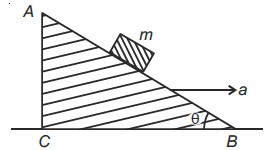
Neet pseodo force questions

For the block to remain stationary relative to the wedge,

the component of  pseudo force up the incline balances the gravitational component along down the incline:
macos⁡θ=mgsin⁡θma \cos \theta = mg \sin \theta

⇒ a=gtan⁡θ

Question 72:

easy

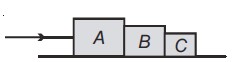
Three blocks A, B and C of masses 4 kg, 2 kg and 1 kg respectively, are in contact on a frictionless surface, as shown. If a force of 14 N is
applied on the 4 kg block, then the contact force between A and B is

connected body nlm

The total mass of the system:

M=4+2+1=7 kgM = 4 + 2 + 1 = 7 \text{ kg}

The acceleration of the system:

a=Total ForceTotal Mass=147=2 m/s2a = \frac{\text{Total Force}}{\text{Total Mass}} = \frac{14}{7} = 2 \text{ m/s}^2

Now, considering block B and C together (mass =

2+1=32 + 1 = 3

kg), the force required to accelerate them:

FAB=(3×2)=6 NF_{AB} = (3 \times 2) = 6 \text{ N}

Thus, the contact force between A and B is 6 N.

Question 73:

moderate

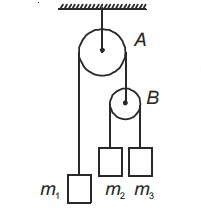
In the arrangement, shown in figure, pulleys A and B are massless and frictionless and threads are ideal. Block of mass m1 will remain at rest if: 


nlm constrained motion

nlm constrained motion

In the movable pulley system, tension in the string connecting m2 and m3 is:

T=2m2m3gm2+m3T = \frac{2 m_2 m_3 g}{m_2 + m_3}

Since this tension acts twice to balance

m1m_1

, we equate:

2T=m1g⇒4m2m3gm2+m3=m1g2T = m_1 g \Rightarrow \frac{4 m_2 m_3 g}{m_2 + m_3} = m_1 g

Cancelling

gg

and rearranging gives:

4m1=1m2+1m3\boxed{ \frac{4}{m_{1}} = \frac{1}{m_{2}} + \frac{1}{m_{3}} }

Question 74:

easy

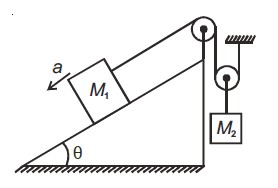
If acceleration of block m1 is a downward then acceleration of block m2 will be:

neet constraint motion questions


For ideal pulleys, the product of tension and acceleration remains constant:


T1a=T2a2T_1 a = T_2 a_2


Since

T2=2T1T_2 = 2T_1

, substitute to get:


T1a=2T1a2⇒a2=a2T_1 a = 2T_1 a_2 \Rightarrow a_2 = \frac{a}{2}


So, M2 accelerates upward with a2\boxed{\text{So, } M_2 \text{ accelerates upward with } \frac{a}{2}}


Question 75:

easy

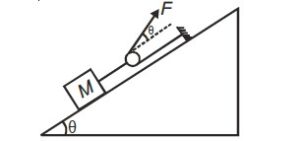
What is the minimum value of F needed so that block begins to move upward on frictionless incline plane as shown?

nlm constrainted motion quesiton 9

🔹 Step-by-step:

  • Block of mass M is on a frictionless incline of angle
    \theta
     
  • Force
    FF
     

    is applied via a pulley system, split into two components:

    • One acts up along the incline: F
    • One acts horizontally, which when resolved along the incline becomes: F
      cos⁡θF \cos \theta
       

Total upward force along incline =

F+Fcos⁡θF + F \cos \theta

Downward component of weight =

Mgsin⁡θMg \sin \theta


🔹 For the block to just start moving upward:

F+Fcos⁡θ=Mgsin⁡θ F(1+cos⁡θ)=Mgsin⁡θ F=Mgsin⁡θ1+cos⁡θF = \frac{Mg \sin \theta}{1 + \cos \theta}

Now use the identity:

sin⁡θ1+cos⁡θ=cot⁡(θ2)\frac{\sin \theta}{1 + \cos \theta} = \cot\left(\frac{\theta}{2}\right)

 Final Answer:

F=Mgcot⁡(θ2)\boxed{F = Mg \cot\left(\frac{\theta}{2}\right)}


Question 76:

difficult

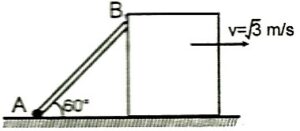
A rod AB is shown in figure. End A of the rod is fixed on the ground. Block is moving with velocity √3 m/s towards right. The velocity of end B of rod when rod makes an angle of 600 with the ground is:

Question 77:

moderate

A 1 kg object strikes a wall with velocity \(1\text{ ms}^{-1}\) at an angle of \(60^\circ\) with the wall and reflects at the same angle. If it remains in contact with wall for 0.1 s, then the force exerted on the wall is

The angle with the normal is \(90^\circ - 60^\circ = 30^\circ\). The change in momentum perpendicular to the wall is \(\Delta p = 2mv\cos(30^\circ) = 2(1)(1)\left(\frac{\sqrt{3}}{2}\right) = \sqrt{3}\text{ kg m s}^{-1}\). Average force \(F = \frac{\Delta p}{\Delta t} = \frac{\sqrt{3}}{0.1} = 10\sqrt{3}\text{ N}\).

Question 78:

moderate

A \(3.0\text{ kg}\) mass is moving in a plane, with its x and y coordinates given by \(x = 24t^2 – 1\) and \(y = 3t^3 + 2\), where x and y are in meters and t is in second. Find the magnitude of the net force acting on this mass at \(t = 2\text{ sec}\).

Differentiating position equations twice yields accelerations: \(a_x = 48\text{ m/s}^2\) and \(a_y = 18t\text{ m/s}^2\). At \(t = 2\text{ s}\), \(a_y = 36\text{ m/s}^2\). Total acceleration \(a = \sqrt{a_x^2 + a_y^2} = 60\text{ m/s}^2\). The net force is \(F = ma = 3.0 \times 60 = 180\text{ N}\).

Question 79:

easy

A body in equilibrium will not have :

For a body in equilibrium, the net external force acting on it is zero. According to Newton's second law, \(F_{\\text{net}} = ma = 0\), which means the acceleration of the body must be zero.

Question 80:

easy

A vehicle of mass m is moving on a rough horizontal road with momentum P. If the coefficient of friction between the tyres and the road be \(\ \mu\), then the stopping distance is:

The stopping distance is given by \(s = \frac{v^2}{2a}\), where the frictional retardation is \(a = \mu g\). Substituting the relation for momentum \(v = \frac{P}{m}\) into the formula yields \(s = \frac{P^2}{2\mu m^2g}\).