Acceleration Due to Gravity and its variation - NEET Physics Chapterwise MCQs & PYQs
Rankers Physics
One Stop for Your NEET Physics Preparation
NEET Acceleration Due to Gravity and its variation MCQs & PYQs
Practice NEET Acceleration Due to Gravity and its variation Questions
Question 11:
easy
The mass of the moon is about 1.2% of the mass of the earth. compared to the gravitational force the earth exerts on the moon, the gravitational force the moon exerts on earth :
From Newton's Third law of motion force applied by object A on B and Force applied by B on A will have equal magnitude.
The average density of the Earth (\( \rho \)) is directly proportional to the acceleration due to gravity (\( g \)) at the surface due to the relationship expressed by the formula:
\[
g = \frac{G M}{R^2},
\]
where:
- \( G \) is the gravitational constant,
- \( M \) is the mass of the Earth,
- \( R \) is the radius of the Earth.
The mass \( M \) can be expressed in terms of density and volume:
\[
M = \rho V = \rho \left( \frac{4}{3} \pi R^3 \right).
\]
Substituting this into the equation for \( g \):
\[
g = \frac{G \left( \rho \cdot \frac{4}{3} \pi R^3 \right)}{R^2} = \frac{4\pi G \rho R}{3}.
\]
This shows that \( g \) is directly proportional to \( \rho \) (as \( R \) and \( G \) are constants), meaning that as the average density of the Earth increases, the value of \( g \) also increases.
Two types of balances, the beam balance and the spring balance are commonly used for measuring weight at shops. If we are at the moon, we can continue to use :
On the Moon, the acceleration due to gravity is weaker (about \( \frac{1}{6} \) of that on Earth), affecting how a spring balance measures weight.
A spring balance relies on the gravitational force to measure weight based on the stretch of the spring, so it would give a lower reading on the Moon.
In contrast, a beam balance compares masses based on equilibrium, unaffected by gravity. Thus, it can be used without any change to measure weight accurately on the Moon.
A body released from a height h takes time t to reach earth’s surface. The time taken by the same body released from the same height to reach the moon’s surface is :
The time taken for an object to fall freely from a height \( h \) is given by the equation:
\[
h = \frac{1}{2} g t^2,
\]
where \( g \) is the acceleration due to gravity.
1. For Earth:
\[
h = \frac{1}{2} g_E t^2 ; t = \sqrt{\frac{2h}{g_E}}.
\]
2. For the Moon, where \( g_M \approx \frac{1}{6} g_E \):
\[
h = \frac{1}{2} g_M t_m^2 ; t_m = \sqrt{\frac{2h}{g_M}} = \sqrt{\frac{2h}{\frac{1}{6} g_E}} = \sqrt{12 \cdot \frac{2h}{g_E}}.
\]
This can be simplified using the time \( t \) from Earth:
\[
t_m = \sqrt{6} \cdot t = \sqrt{6} \cdot t.
\]
Thus, the time taken by the same body to reach the Moon's surface is approximately \( \sqrt{6} t \).
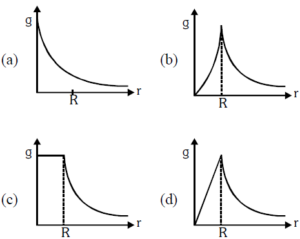
The dependence of acceleration due to gravity ‘g’ on the distance ‘r’ from the centre of the earth, assumed to be a sphere of radius R of uniform density, is as shown in figure below:-
If \(R\) is the radius of the earth and \(g\) is the acceleration due to gravity on the earth surface. Then the mean density of the earth will be
Acceleration due to gravity is \(g = \frac{GM}{R^2}\). Since mass \(M = \rho \times \frac{4}{3}\pi R^3\), we get \(g = \frac{G \left(\frac{4}{3}\pi R^3 \rho\right)}{R^2} = \frac{4}{3}\pi \rho GR\). Rearranging gives \(\rho = \frac{3g}{4\pi RG}\).
Consider earth to be a homogeneous sphere. Scientist A goes deep down in a mine and scientist B goes high up in a balloon. The value of g measured by:
Acceleration due to gravity decreases with depth as \( g_d = g(1 - \frac{d}{R}) \) and with height as \( g_h = g(1 - \frac{2h}{R}) \). Since the formulas and rates of decrease are different, they decrease at different rates.
Two planets of radii in the ratio 2 : 3 are made from the material of density in the ratio 3 : 2. Then the ratio of acceleration due to gravity \( g_1 / g_2 \) at the surface of the two planets will be:
Acceleration due to gravity at the surface of a planet is given by \( g = \frac{4}{3} \pi G R \rho \). Therefore, \( \frac{g_1}{g_2} = \frac{R_1}{R_2} \times \frac{\rho_1}{\rho_2} = \frac{2}{3} \times \frac{3}{2} = 1 \).
The height at which the weight of a body becomes 1/9th its weight on the surface of earth (radius of earth is R):
Since acceleration due to gravity varies with height as \(g' = g \frac{R^2}{(R+h)^2}\), setting \(g' = g/9\) gives \(R+h = 3R\), which simplifies to \(h = 2R\).