Question 1:
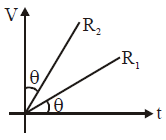
moderateThe V-I graph for two conductor of resistance R1 & R2 are as shown in the figure, the resistance of their series combination (R2 + R1) is proportional to :
Question 1:
moderateThe V-I graph for two conductor of resistance R1 & R2 are as shown in the figure, the resistance of their series combination (R2 + R1) is proportional to :
Question 2:
moderateIf the number of free electrons is \(5\times 10^{28} m^{-3}\) then the drift velocity of electron in a conductor of area of cross-section \(10^{-4} m^{2}\) for a current of 1.2 A is:
To find the drift velocity
of the electrons, we use the formula for current in terms of drift velocity:
Where:
is the current (1.2 A),
is the number of free electrons per unit volume (
),
is the cross-sectional area of the conductor (
),
is the charge of an electron (
),
is the drift velocity of the electrons (which we need to calculate).
The drift velocity of the electrons is
.
Question 3:
easyA wire is stretched so that its length increases by 10%. The resistance of the wire increases by :
When a wire is stretched, its length increases, and its cross-sectional area decreases. The resistance of a wire is given by the formula:
Where:
is the resistance,
is the resistivity of the material (constant),
is the length of the wire,
is the cross-sectional area of the wire.
is given by:
Since the volume remains constant:
Solving for
, the new cross-sectional area:
The new resistance
of the stretched wire is given by:
So, the new resistance
is 1.21 times the original resistance
.
The resistance increases by 21% when the wire is stretched by 10%.
Question 4:
easyThe specific resistance of a wire :
Specific resistance is property of substance it doesn't depend on any other physical factor
Question 5:
moderateA battery of emf E is connected across a conductor as shown. As one observes from A to B.
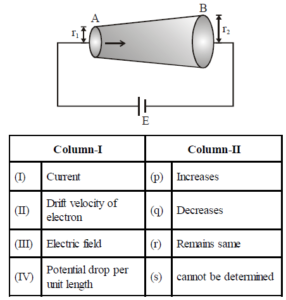
Now, match the given columns and select the correct option from the codes given below :
Codes :
Question 6:
moderateThe resultant resistance value of n resistance each of r ohm when connected in parallel, is x. When these n resistances are connected in series, the resultant value is :
Let's break this down step by step.
When
resistors, each of resistance
, are connected in parallel, the total or equivalent resistance
is given by the formula:
This simplifies to:
So, the equivalent resistance is:
We're told that the resultant resistance when connected in parallel is
, so:
When the same
resistors, each of resistance
, are connected in series, the total or equivalent resistance
is simply the sum of the individual resistances:
So:
From the parallel connection, we know that:
Thus, the resistance when the resistors are connected in series is:
Therefore, the resistance when these
resistors are connected in series is:
Question 7:
moderateThree copper wires have lengths and cross-sectional areas as : (l, A), (2l, A/2) and (l/2, 2A). Resistance is minimum in :
The resistance
of a wire is given by the formula:
Where:
is the resistivity of the material (which is constant for copper),
is the length of the wire,
is the cross-sectional area of the wire.
, Area =
, Area =
, Area =
We will calculate the resistance for each wire.
Clearly,
is the smallest resistance because
is the smallest fraction compared to
and
.
The wire with the minimum resistance is Wire 3, which has a cross-sectional area of
.
Thus, the answer is Wire 3.
Question 8:
moderateThe number of free electrons per 100 mm of ordinary copper wire is /[ 2 \times 10^{21} /] . Average drift speed of electrons is 0.25 mm/s. The current flowing is :
The current I is calculated by:
Thus, the correct answer is 0.8 A (Option 4)
Question 9:
easyIn a wire of cross-section radius \(r\), free electrons travel with drift velocity \(v\) when a current \(I\) flows through the wire. What is the current in another wire of half the radius and of the same material when the drift velocity is \(2v\)?
Since \(I = n e A v_d = n e \pi r^2 v\), the new current is \(I' = n e \pi \left(\frac{r}{2}\right)^2 (2v) = \frac{1}{2} n e \pi r^2 v = I/2\).
Question 10:
easyAssertion (A): When constant current is passing through a conductor of variable area of cross section, electric field inside conductor is inversely proportional to cross sectional area.
Reason (R): Microscopic form of Ohm’s law is \( \vec{E} = \rho \vec{J} \), where \( \vec{E} \) stands for electric field, \( \rho \) stands for resistivity and \( \vec{J} \) stands for current density.
Assertion (A) is true because \( I = JA \) and \( E = \rho J \) imply \( E = \frac{\rho I}{A} \). Reason (R) is true as it's the microscopic form of Ohm's law. Reason correctly explains assertion.