Question 21:
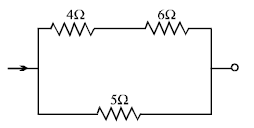
difficultFor given circuit, heat produced by a current in resistance of 5Ω is 10 Cal/sec. Then the heat produced in resistance of 4Ω is
Question 21:
difficultFor given circuit, heat produced by a current in resistance of 5Ω is 10 Cal/sec. Then the heat produced in resistance of 4Ω is
Question 22:
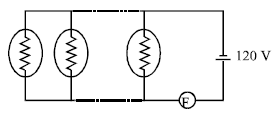
moderateSome light bulbs are conected in parallel to a 120 V source as shown in the figure. Each bulb dissipates an average power of 60 W.The circuit has a fuse F that burns out when the current in the circuit exceeds 9 A. Determine the largest number of bulbs of the following, that can be used in the circuit without burning out the fuse.
Question 23:
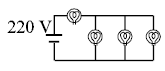
moderateFour identical bulbs each rated 100 watts, 220 volts are connected across a battery as shown. The power consumed by them is:
Question 24:
moderateSix identical light bulbs are connected to a battery to form the circuit shown. Which light bulb(s) glow the brightest?
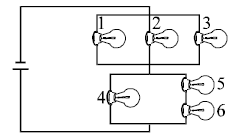
Current through bulb 4 is maximum
Question 25:
easyA carbon resistor is marked with the rings coloured brown, black green and gold. The resistance (in ohm) is :
To determine the resistance of a carbon resistor with color bands brown, black, green, and gold, use the color code for resistors:
(1st digit)
(2nd digit)
(multiplier)
(tolerance)
The resistance is calculated as:
Substitute values:
This is equal to:
The gold band indicates a tolerance of
, so the resistance can vary between:
The resistance is:
Question 26:
moderateN identical cells, each of emf e and internal resistance r, are joined in series. Out of these, n cells are wrongly connected, i.e., their terminals are connected in reverse of that required for series connection. n < N/2. Let \(\varepsilon_{0}\) be the emf of the resulting battery and \( r_{0}\) be its internal resistance,
When
identical cells, each of emf
and internal resistance
, are connected in series and
cells are connected in reverse, the resulting emf and internal resistance of the battery can be determined as follows:
The net emf of the resulting battery is:
The emf and internal resistance of the resulting battery are:
Question 27:
moderateThe ratio of the resistance of conductor at temperature 15°C to its resistance at temperature 37.5°C is 4 : 5. the temperature coefficient of resistance of the conductor is : (reference is taken as 0°C)
To find the temperature coefficient of resistance
of the conductor, we use the formula for the change in resistance with temperature:
Where:
is the resistance at temperature
,
is the resistance at the reference temperature (0°C),
is the temperature coefficient of resistance,
is the temperature change in °C.
.
.
.
Substituting the expressions for
and
:
Canceling
from both the numerator and denominator:
Cross-multiply to solve for
:
Expanding both sides:
Simplify:
The temperature coefficient of resistance
is
.
Question 28:
moderateThe equivalent resistance of the network shown in the figure between the points A and B is :-
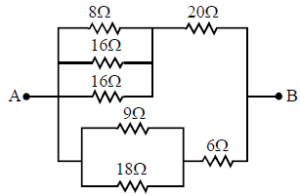
Question 29:
moderateThe effective resistance across the points A and I is :-
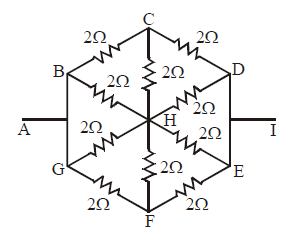
Question 30:
moderateThe resultant resistance value of n resistance each of r ohm when connected in parallel, is x. When these n resistances are connected in series, the resultant value is :
Let's break this down step by step.
When
resistors, each of resistance
, are connected in parallel, the total or equivalent resistance
is given by the formula:
This simplifies to:
So, the equivalent resistance is:
We're told that the resultant resistance when connected in parallel is
, so:
When the same
resistors, each of resistance
, are connected in series, the total or equivalent resistance
is simply the sum of the individual resistances:
So:
From the parallel connection, we know that:
Thus, the resistance when the resistors are connected in series is:
Therefore, the resistance when these
resistors are connected in series is: