Capacitors - NEET Physics Chapterwise MCQs & PYQs

NEET Capacitors MCQs & PYQs

Question 21:

moderate

Minimum number of 8 μF and 250 V capacitors used to make a combination of 16 μF and 1000 V are:

To solve this, we determine the combination of capacitors required to achieve the desired capacitance and voltage.


Given:

  • Individual capacitor:
    C=8 μFC = 8 \, \mu\text{F}
     

    , Vmax=250 VV_{\text{max}} = 250 \, \text{V} 

  • Desired combination:
    Creq=16 μFC_{\text{req}} = 16 \, \mu\text{F}
     

    , Vreq=1000 VV_{\text{req}} = 1000 \, \text{V} 


Step 1: Voltage requirement

To achieve

Vreq=1000 VV_{\text{req}} = 1000 \, \text{V}

, multiple capacitors must be connected in series because the voltage across a series combination adds up. The number of capacitors required in series is:


n=VreqVmax=1000250=4n = \frac{V_{\text{req}}}{V_{\text{max}}} = \frac{1000}{250} = 4


Thus, 4 capacitors in series are required to handle 1000 V.


Step 2: Capacitance in series

The effective capacitance of

nn

capacitors in series is given by:


Cseries=Cn=84=2 μFC_{\text{series}} = \frac{C}{n} = \frac{8}{4} = 2 \, \mu\text{F}


So, a series of 4 capacitors provides

Cseries=2 μFC_{\text{series}} = 2 \, \mu\text{F}

.


Step 3: Capacitance requirement

To achieve

Creq=16 μFC_{\text{req}} = 16 \, \mu\text{F}

, multiple such series groups must be connected in parallel because capacitance in parallel adds up. The number of such series groups required is:


m=CreqCseries=162=8m = \frac{C_{\text{req}}}{C_{\text{series}}} = \frac{16}{2} = 8


Thus, 8 series groups are required.


Step 4: Total capacitors

Each series group contains 4 capacitors, and there are 8 such groups. Therefore, the total number of capacitors is:


Total capacitors=n⋅m=4⋅8=32\text{Total capacitors} = n \cdot m = 4 \cdot 8 = 32


Final Answer:

The minimum number of capacitors required is:
 

32\boxed{32}


Question 22:

difficult

Three capacitors 2 μF, 3 μF and 5 μF can withstand voltages to 3V, 2V and 1V respectively. Their series combination can withstand a maximum voltage equal to

Let's verify and calculate the correct answer step-by-step:

Given Data:

  • Capacitances:
    C1=2 μF,C2=3 μF,C3=5 μFC_1 = 2 \, \mu\text{F}, C_2 = 3 \, \mu\text{F}, C_3 = 5 \, \mu\text{F}
     
  • Maximum voltages:
    V1=3 V,V2=2 V,V3=1 VV_1 = 3 \, \text{V}, V_2 = 2 \, \text{V}, V_3 = 1 \, \text{V}
     

Step 1: Maximum charge each capacitor can store:


Q1=C1⋅V1=2⋅3=6 μCQ_1 = C_1 \cdot V_1 = 2 \cdot 3 = 6 \, \mu\text{C}


Q2=C2⋅V2=3⋅2=6 μCQ_2 = C_2 \cdot V_2 = 3 \cdot 2 = 6 \, \mu\text{C}


Q3=C3⋅V3=5⋅1=5 μCQ_3 = C_3 \cdot V_3 = 5 \cdot 1 = 5 \, \mu\text{C}


The capacitor with the minimum charge capacity limits the system. Here,

Qmax=5 μCQ_{\text{max}} = 5 \, \mu\text{C}

, dictated by

C3C_3

.


Step 2: Voltage distribution across each capacitor:

In series, charge

QQ

is the same on all capacitors, and the voltage across each capacitor is:


V1=QC1,V2=QC2,V3=QC3V_1 = \frac{Q}{C_1}, \quad V_2 = \frac{Q}{C_2}, \quad V_3 = \frac{Q}{C_3}


Total voltage across the series combination:


Vtotal=V1+V2+V3V_{\text{total}} = V_1 + V_2 + V_3


Substitute

Q=5 μCQ = 5 \, \mu\text{C}

:


V1=52=2.5 V,V2=53≈1.67 V,V3=55=1 VV_1 = \frac{5}{2} = 2.5 \, \text{V}, \quad V_2 = \frac{5}{3} \approx 1.67 \, \text{V}, \quad V_3 = \frac{5}{5} = 1 \, \text{V}


Step 3: Total voltage:


Vtotal=V1+V2+V3=2.5+1.67+1=156+106+66=316 V.V_{\text{total}} = V_1 + V_2 + V_3 = 2.5 + 1.67 + 1 = \frac{15}{6} + \frac{10}{6} + \frac{6}{6} = \frac{31}{6} \, \text{V}.


Final Answer:

The maximum voltage the series combination can withstand is:


316 V≈5.17 V.\boxed{\frac{31}{6} \, \text{V}} \approx 5.17 \, \text{V}.


Question 23:

difficult

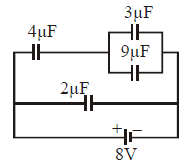
A combination of capacitors is set up as shown in the figure. The magnitude of the electric field, due to a point charge Q (having a charge equal to the sum of the charges on the 4μF and 9μF capacitors), at a point distant 30 m from it, would equal :

Question 24:

moderate

A parallel plate capacitor of capacitance C consists of two identical plates A and B. A charge q is given to plate A and charge –q is given to plate B. The space between plates is vacuum. The separation between plates is d. The electric intensity at a point situated between plates is :

Question 25:

difficult

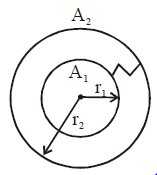
Two spherical conductors A1 and A2 of radii r1 and r2 are placed concentrically in air. The two are connected by a copper A wire as shown in figure. Then the equivalent capacitance of the system is :

The problem involves two spherical conductors

A1A_1

and

A2A_2

connected by a copper wire. Let’s analyze and compute the equivalent capacitance of the system.

Given:


  • A1A_1
     

    and A2A_2 

    are concentric spherical conductors.

  • Radii of the spheres:
    r1r_1
     

    (inner) and r2r_2 

    (outer).

  • The medium is air, so the permittivity is
    ε0\varepsilon_0
     

    .

Key Concepts:

  1. Potential Difference Between the Spheres: The two conductors are connected by a wire, meaning they are at the same potential. As a result, the electric field exists only between the two spheres.
  2. Capacitance of a Single Isolated Sphere: If only
    A2A_2
     

    existed as a spherical conductor, its capacitance would be: 

    Csingle=4πε0r2.C_{\text{single}} = 4 \pi \varepsilon_0 r_2. 

  3. Why the System is Equivalent to an Isolated Sphere: Since
    A1A_1
     

    is connected to A2A_2 

    via a conducting wire, any charge added to A1A_1 

    immediately flows to A2A_2 

    , making the system behave as if there is only one conductor of radius r2r_2 

    .

Equivalent Capacitance:

Thus, the capacitance of the system is:


Cequivalent=4πε0r2.C_{\text{equivalent}} = 4 \pi \varepsilon_0 r_2.


Final Answer:

The equivalent capacitance of the system is:


4πε0r2.\boxed{4 \pi \varepsilon_0 r_2}.


Question 26:

moderate

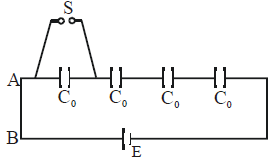
In the given figure, find the charge flowing through section AB when switch S is closed:


When Switch is open Ceq= C/4 Charge given by the Battery is CE/4.

When Switch is open Ceq= C/3 Charge given by the Battery is CE/3.

Extra Charge flowing through the circuit it = \( \frac{CE}{3}-\frac{CE}{4}= \frac{CE}{12}\)


Question 27:

moderate

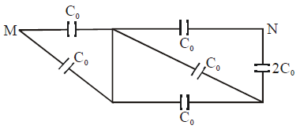
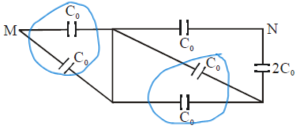
The equivalent capacitance between points M and N is:

Combination of Capacitors

Circircled ones are in parallel

Question 28:

easy

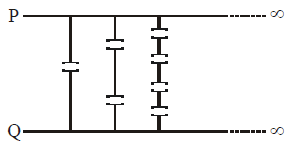
If each capacitor has C = I F, the capacitance across P and Q is:


First Branch has a capacitance of 1F , for second branch it is 1/2F , for third branch it is 1/4 F and so, on . As all these branches are in parallel

\[ C_{eq}=C_{1}+C_{2}+C_{3}+....\]

\[ C_{eq}= 1 + \frac{1}{2} + \frac{1}{4}+ \frac{1}{8}+....=\frac{1}{1-\frac{1}{2}}=2\mu F\]

Question 29:

difficult

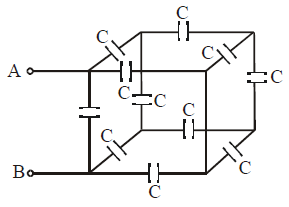
The equivalent capacitance between A and B is :

To find the equivalent capacitance for this cubical capacitor network, where each edge of the cube has a capacitance

CC

, here’s the shortest solution:

Step-by-Step:

  1. Symmetry analysis:
    • By symmetry, all corners of the cube can be grouped into equivalent potential nodes.
    • The cube's symmetry allows reduction to a simpler circuit.
  2. Key nodes:
    • Node
      AA
       

      is connected to one corner of the cube.

    • Node
      BB
       

      is connected to the diagonally opposite corner.

  3. Effective connections:
    • Due to symmetry, three capacitors are effectively in parallel between
      AA
       

      and an intermediate point.

    • Similarly, three capacitors are effectively in parallel between
      BB
       

      and the same intermediate point.

    • Two capacitors remain directly between
      AA
       

      and BB 

      .

  4. Simplification:
    • The three parallel capacitors at each node result in:
      Cparallel=3CC_{\text{parallel}} = 3C
       
    • The equivalent circuit becomes two
      3C3C
       

      capacitors in series with a 2C2C 

      capacitor: Series combination:1Ceq=13C+13C+12C\text{Series combination:} \quad \frac{1}{C_{\text{eq}}} = \frac{1}{3C} + \frac{1}{3C} + \frac{1}{2C} 

  5. Calculation:
    • Combine series:
      1Ceq=23C+12C=46C+36C=76C\frac{1}{C_{\text{eq}}} = \frac{2}{3C} + \frac{1}{2C} = \frac{4}{6C} + \frac{3}{6C} = \frac{7}{6C}
       
    • Invert to find
      CeqC_{\text{eq}}
       

      : Ceq=6C7×2=12C7C_{\text{eq}} = \frac{6C}{7} \times 2 = \frac{12C}{7} 

Thus, the equivalent capacitance is:


Ceq=12C7C_{\text{eq}} = \frac{12C}{7}


Question 30:

easy

A capacitor is charged by using a battery, which is then disconnected. A dielectric slab is then slided between the plates which results in :

Let's break down the situation step by step:

Given:

  • A capacitor is charged using a battery and then disconnected (so no current can flow after disconnection).
  • A dielectric slab is inserted between the plates of the capacitor after disconnecting the battery.

Key concepts:

  • Capacitance with Dielectric: When a dielectric slab is inserted, the capacitance of the capacitor increases. The new capacitance
    C′C'
     

    is related to the original capacitance CC 

    by the dielectric constant KK 

    : 

    C′=K⋅CC' = K \cdot Cwhere

    KKis the dielectric constant of the material.

  • Charge on the Plates: Since the capacitor is disconnected from the battery, no additional charge can flow onto the plates. Thus, the charge
    QQ
     

    remains the same, given by: 

    Q=Câ‹…VQ = C \cdot Vwhere

    VVis the potential difference across the plates. Since the charge remains constant, the equation becomes:


    Q=C′⋅V′Q = C' \cdot V'where

    V′V'is the new potential difference across the plates.

  • Potential Difference: Since the capacitance increases and the charge stays constant, the potential difference
    V′V'
     

    must decrease (because Q=C′⋅V′Q = C' \cdot V' 

    and C′>CC' > C 

    ).

  • Stored Energy: The energy stored in a capacitor is given by: 

    U=Q22CU = \frac{Q^2}{2C}Since the capacitance increases and the charge is constant, the stored energy

    UUdecreases, as it is inversely proportional to the capacitance.

Conclusion:

  • Decrease in potential difference: The potential difference across the plates decreases because the capacitance increases while the charge remains constant.
  • Reduction in stored energy: The energy stored in the capacitor decreases because the capacitance increases.
  • No change in charge: The charge on the plates remains the same since the capacitor is disconnected from the battery.

Thus, the correct answer is: "Decrease in the potential difference across the plates, reduction in stored energy, but no change in the charge on the plates."