Gauss's Law: Practice Problem & Solution
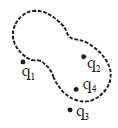
In the arrangement of charges shown, the dotted boundary represents a Gaussian surface . For this surface , Gauss's law has the form \[ \oint_{}^{}\overrightarrow{E}.\overrightarrow{ds}=\frac{q}{\varepsilon_{0}} .\] Select the correct alternative \[ \overrightarrow{E_{1}},\overrightarrow{E_{2}}, \overrightarrow{E_{3}} and \overrightarrow{E_{4}} \] are electric field vectors due to these four charges respectively.
Short Solution (Best for NEET):
To solve this problem, we apply the core principles of Gauss's Law. Understanding the underlying formula is key to arriving at the correct answer below:
In Gauss law q represents total charge enclosed within the gaussian surface. so,
\[ q= q_{2} + q_{4}\]
Leave a Reply