Coulomb's Law: Practice Problem & Solution
An isolated charge q1 of mass m is suspended freely by a thread of length l. Another charge q2 is brought near it (r >>l). When q1 is equilibrium, tension in thread will be :
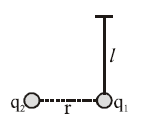
Short Solution (Best for NEET):
To solve this problem, we apply the core principles of Coulomb's Law. Understanding the underlying formula is key to arriving at the correct answer below:
Solution Outline:
1. Forces Acting on \( q_1 \):
- Gravitational Force: \( F_g = mg \), acting vertically downward.
- Electrostatic Force: \( F_e = \frac{k |q_1 q_2|}{r^2} \), acting horizontally toward \( q_2 \).
2. Resultant Tension \( T \)
Since \( q_1 \) is in equilibrium, the tension \( T \) in the thread must balance both the gravitational and electrostatic forces. The tension will act diagonally, with components to counteract both the vertical \( mg \) and horizontal \( F_e \) forces.
3. Calculating \( T \):
Using vector addition, we find \( T \) as:
\[
T = \sqrt{(mg)^2 + \left( \frac{k |q_1 q_2|}{r^2} \right)^2}
\]
Since \( \frac{k |q_1 q_2|}{r^2} \) is a positive quantity, \( T \) is indeed greater than \( mg \).
Conclusion:
The correct answer is:
\[
T > mg
\]
Leave a Reply