Relative Motion in Two Dimension - NEET Physics Questions
← Back to Kinematics

Relative Motion in Two Dimension

Question 11: easy

A boat is sailing with a velocity \[\left( 3\hat{i}+4\hat{j} \right)\] with respect to ground and water in river is flowing with a velocity

\[\left( -3\hat{i}-4\hat{j} \right)\] . Relative velocity of the boat with respect to water is :

1. \[8\hat{j}\]
2. 5√2
3. \[6\hat{i}+8\hat{j}\]
4. \[-6\hat{i}-8\hat{j}\]
View Answer

The relative velocity of the boat with respect to the water is given by subtracting the velocity of the water from the velocity of the boat.

\[
\vec{v}_{\text{bw}} = \vec{v}_{\text{boat}} - \vec{v}_{\text{water}}
\]

Given:
\[
\vec{v}_{\text{boat}} = 3\hat{i} + 4\hat{j}, \quad \vec{v}_{\text{water}} = -3\hat{i} - 4\hat{j}
\]

Now, subtract:

\[
\vec{v}_{\text{bw}} = (3\hat{i} + 4\hat{j}) - (-3\hat{i} - 4\hat{j})
\]
\[
\vec{v}_{\text{bw}} = 3\hat{i} + 4\hat{j} + 3\hat{i} + 4\hat{j}
\]
\[
\vec{v}_{\text{bw}} = 6\hat{i} + 8\hat{j}
\]

Thus, the relative velocity of the boat with respect to the water is:

\[ {6\hat{i} + 8\hat{j}} \]
Question 12: difficult

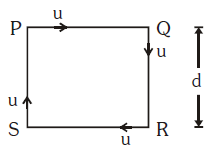
Four persons P, Q, R and S of same mass travel with same speed u along a square of side ‘d’ such that each one always faces the other. After what time will they meet each other ?

1. \[\frac{d}{u}\]
2. \[\frac{2d}{3u}\]
3. \[\frac{2d}{u}\]
4. d√3u
View Answer

To determine when the four persons \( P, Q, R, \) and \( S \) will meet, consider the following:

Relative Velocity:
- Each person moves with speed \( u \) towards the center of the square.

Configuration:
- As they face each other and move towards the center, their paths converge.

Effective Speed Towards Each Other:
- The effective speed of each person towards the center is \( u \cos 45^\circ = \frac{u}{\sqrt{2}} \) because they move diagonally.

Distance to Center:
- The distance from each person to the center of the square is \( \frac{d}{\sqrt{2}} \).

Time to Meet:
\[
t = \frac{\text{Distance}}{\text{Effective Speed}} = \frac{\frac{d}{\sqrt{2}}}{\frac{u}{\sqrt{2}}} = \frac{d}{u}
\]

Thus, the time after which they will all meet is \( \frac{d}{u} \).

Question 13: easy

A river \(2\text{ km}\) wide flows at the rate of \(2\text{km/h}\). A boatman who can row a boat at a speed of \(6\text{ km/h}\ in still water, goes a distance of \(2\text{ km}\ upstream and then comes back. The time taken by him to complete his journey is

1. 60 min
2. 45 min
3. 80 min
4. 90 min
View Answer

Boat speed in still water \(v_b = 6\text{ km/h}\), river speed \(v_r = 2\text{ km/h}\). Upstream speed \(v_u = v_b - v_r = 4\text{ km/h}\). Downstream speed \(v_d = v_b + v_r = 8\text{ km/h}\). Time upstream \(t_u = 2\text{ km} / 4\text{ km/h} = 0.5\) hours. Time downstream \(t_d = 2\text{ km} / 8\text{ km/h} = 0.25\) hours. Total time = \(0.5 + 0.25 = 0.75\) hours = \(45\) minutes.

Question 14: easy

Two objects \(A\) & \(B\) are moving in a plane with velocities \(\vec{v}_A = (3\hat{i}+4\hat{j})\) m/s and \(\vec{v}_B = (7\hat{i}-3\hat{j})\) m/s respectively. The velocity of object \(A\) with respect to object \(B\) will be (in m/s):

1. \(4\hat{i}-7\hat{j}\)
2. \(4\hat{i}+\hat{j}\)
3. \(7\hat{i}+7\hat{j}\)
4. \(-4\hat{i}+7\hat{j}\)
View Answer

Relative velocity is given by \(\vec{v}_{AB} = \vec{v}_A - \vec{v}_B = (3\hat{i}+4\hat{j}) - (7\hat{i}-3\hat{j}) = -4\hat{i}+7\hat{j}\) m/s. Therefore, option D is correct.

Question 15: easy

A swimmer can swim with speed of \(8\text{ m/s}\) in still water. \(800\text{ m}\) wide river is flowing with speed of \(4\text{ m/s}\). Swimmer wants to cross the river in minimum time. Velocity of swimmer with respect to ground is (approximately)

1. 9 m/s
2. 10 m/s
3. 12 m/s
4. 5 m/s
View Answer

For minimum crossing time, the swimmer must head perpendicular to the river bank. The net ground velocity is the vector sum of swimmer's velocity and river velocity: \(v_g = \sqrt{v_{\text{sw}}^2 + v_r^2} = \sqrt{8^2 + 4^2} = \sqrt{80} \approx 8.94\text{ m/s} \approx 9\text{ m/s}\).

Question 16: easy

A swimmer wants to cross the river in shortest possible time, The angle \(theta\) made by the swimmer with flow of river is

1. \(\theta = 0^\circ\)
2. \(\theta > \frac{\pi}{2}\)
3. \(\theta = \frac{\pi}{2}\)
4. \(0 < \theta < \frac{\pi}{2}\)
View Answer

The time to cross a river is \(t = \frac{d}{v \sin \theta}\), where \(theta\) is the angle with the river flow. For \(t\) to be minimum, \(sin \theta\) must be maximum, which occurs at \(\theta = 90^\circ = \frac{\pi}{2}\).

Question 17: easy

Assertion (A): Two particles start moving with velocities \(vec{v}_1\) and \(vec{v}_2\) respectively in a plane. They can meet only if component of their velocities perpendicular to line joining them are equal.


Reason (R): Relative velocity of a body w.r.t. other body is calculated along the line joining two bodies.


1. Both (A) & (R) are true and the (R) is the correct explanation of the (A)
2. Both (A) & (R) are true but the (R) is not the correct explanation of the (A)
3. (A) is true but (R) is false
4. Both (A) and (R) are false
View Answer

Assertion (A): For particles to meet, their relative perpendicular velocity component must be zero, meaning their perpendicular velocities must be equal. Otherwise, they would move apart perpendicular to the line joining them. So (A) is true.


Reason (R): Relative velocity is a vector difference and can be calculated in any direction, not exclusively along the line joining two bodies. So (R) is false.

Question 18: easy

Assertion (A): The magnitude of velocity of two boats relative to river is same. Both boats start simultaneously from same point on one bank. They may reach opposite bank simultaneously moving along different straight line paths.


Reason (R): For above boats to cross the river in same time, the components of their velocity relative to river in direction normal to flow should be same.


1. Both (A) & (R) are true and the (R) is the correct explanation of the (A)
2. Both (A) & (R) are true but the (R) is not the correct explanation of the (A)
3. (A) is true but (R) is false
4. Both (A) and (R) are false
View Answer

The time to cross the river depends on the component of velocity perpendicular to the river flow (\(v_{\text{normal}}\)). For simultaneous crossing, \(v_{\text{normal}}\) must be equal for both boats. If total speed relative to river is same, and \(v_{\text{normal}}\) is same, then the magnitude of the parallel component is also same. Different paths result from different directions of the parallel component. Thus, (A) is true and (R) is true and explains (A).