Question 11:
easyThe angle of minimum deviation for a prism is 40° and the angle of the prism is 60°. The angle of incidence in the position will be
Question 11:
easyThe angle of minimum deviation for a prism is 40° and the angle of the prism is 60°. The angle of incidence in the position will be
Question 12:
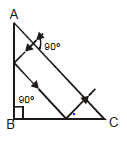
difficultA ray falls on a prism ABC (AB = BC) and travels as shown in figure. The minimum refractive index of the prism material should be
Question 13:
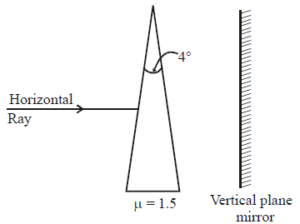
difficultFor the situations shown in the figure, determine the angle by which the mirror should be rotated, so that the light ray will retrace its path after refraction through the prism and reflection from the mirror ?
Question 14:
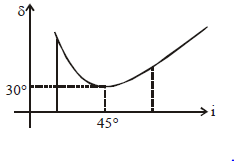
moderateVariation of angle of deviation δ versus angle of incidence for a prism is given the figure. The value of refractive index of prism :
Question 15:
easyRefractive index of a prism is \(cosec(A/2)\). Then minimum angle of deviation is :
Using the prism formula: \(mu = \frac{sin((A+\delta_m)/2)}{sin(A/2)}\). Substituting \(mu = cosec(A/2) =\frac{1}{sin(A/2)}\), we get \(sin((A+\delta_m)/2) = 1 ⇒ (A+\delta_m)/2 = 90^0 ⇒ \delta_m = 180^0 - A\).
Question 16:
easyDispersive power of a prism depends on
Dispersive power (\(\omega\)) of a prism depends only on the nature of the material of the prism, and is independent of the refracting angle and size of the prism.
Question 17:
easyA ray of light is incident normally on one face of a thin prism of refractive index \(mu\) and emerges at an angle (e) from the normal. Angle of prism \(A\) is nearly
For normal incidence on the first face, the angle of refraction \(r_1 = 0\), which implies \(r_2 = A\). Applying Snell's law at the second face for small angles, \(e \approx \mu r_2 = \mu A\), giving \(A \approx \frac{e}{\mu}\).
Question 18:
easyAssertion (A): The sun appears oval shape at sunrise.
Reason (R): At the time of sunrise sun appears a little before the actual sunrise.
Atmospheric refraction causes sunlight to bend as it passes through Earth's atmosphere. This phenomenon makes the sun appear to rise earlier and distorts its shape into an oval or flattened form at the horizon due to differential refraction. Both Assertion (A) and Reason (R) are true, and (R) provides a correct explanation for (A).
Question 19:
easyAssertion (A): Splitting of light into its component colours is possible in refraction at plane surface of two media.
Reason (R): On each refraction dispersion is possible but in prism at both surface dispersion is in same direction so it is clearly seen.
Dispersion, the splitting of light into its constituent colors, occurs during refraction because the refractive index of a medium depends on the wavelength of light. This effect is present at any plane refractive surface. In a prism, the refractions at both surfaces cause deviations for different colors that add up in the same direction, making the overall dispersion more noticeable. Both A and R are true, and R explains A.
Question 20:
easyAssertion (A): When light passes through a prism, it disperses while if the same light passes through a rectangular glass slab of same material, it doesn’t disperse.
Reason (R): Dispersive power of prism is non zero while that of glass slab is zero.
A prism disperses light because its non-parallel surfaces separate colors due to varying refractive indices. A rectangular slab also disperses light internally, but the emergent rays are parallel, resulting in no net angular dispersion. Dispersive power is a material property and is non-zero for any dispersive medium, including glass slabs.