Question 51:
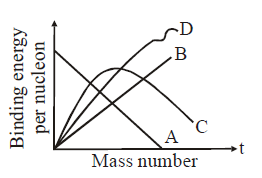
moderateBinding energy per nucleon plot against the mass number for stable nuclei is shown in the figure. Which curve is correct :
Question 51:
moderateBinding energy per nucleon plot against the mass number for stable nuclei is shown in the figure. Which curve is correct :
Question 52:
easyNuclear forces are :
Question 53:
difficultThe binding energy of deuteron \[_{1}^{2}H\] is 1.112 MeV per nucleon and an α-particle
\[_{2}He^{4}\] has a binding energy of 7.047 MeV per nucleon. Then in the fusion reaction
\[_{1}^{2}H+_{1}^{2}H\longrightarrow _{2}^{4}He+Q\] , the energy Q released is :
Question 54:
easyWhich reaction is not the part of proton-proton cycle ?
In the stellar proton-proton chain reaction, deuterium fuses with a proton to form Helium-3, but deuterium does not fuse directly with another deuterium nucleus. Thus, reaction (2) is not part of this cycle.
Question 55:
easyThe ground state energy of hydrogen atom is \(-13.6\text{ eV}\). The energy needed to ionize hydrogen atom from its second excited state will be
Second excited state corresponds to \(n = 3\). The energy is \(E_3 = -\frac{13.6}{3^2} = -1.51\text{ eV}\). The ionization energy required is \(E_{\text{ion}} = 0 - E_3 = 1.51\text{ eV}\).
Question 56:
easyThe maximum kinetic energy of the emitted photoelectrons in photoelectric effects is independent of:
According to Einstein's photoelectric equation, \(K_{\text{max}} = h\nu - \phi\). The maximum kinetic energy depends on the frequency/wavelength of the incident light and the work function, but is independent of the intensity of the light.
Question 57:
easyThe wavelength of Lyman series of hydrogen atom appears in
The Lyman series transitions terminate at the ground state (\(n = 1\)). The photon energies emitted in these transitions correspond to the ultraviolet region of the electromagnetic spectrum.
Question 58:
easyThe de Broglie wavelength associated with an electron, accelerated by a potential difference of 81 V is given by:
The de Broglie wavelength for an electron accelerated through a potential \(V\) is given by \(\lambda = \frac{1.227}{\sqrt{V}}\text{ nm}\). Substituting \(V = 81\text{ V}\), we get \(\lambda = \frac{1.227}{9}\text{ nm} \approx 0.136\text{ nm}\).
Question 59:
easyRatio of shortest wavelengths corresponding to Lyman and Balmer series in hydrogen spectrum is
The shortest wavelength in a series corresponds to transition from \(n_2 = \infty\) to \(n_1\). For Lyman series, \(\lambda_L = \frac{1}{R}\). For Balmer series, \(\lambda_B = \frac{4}{R}\). Therefore, the ratio \(\frac{\lambda_L}{\lambda_B} = \frac{1}{4}\).
Question 60:
easyPhotocell is illuminated by a point source of light, which is placed at a distance \(d\) from the cell. If the distance becomes \(2d\), then number of electrons emitted per second will be
Intensity of light from a point source is inversely proportional to the square of the distance, \(I \propto \frac{1}{d^2}\). Since the number of photoelectrons emitted per second is proportional to intensity, doubling the distance reduces the emission to one-fourth.