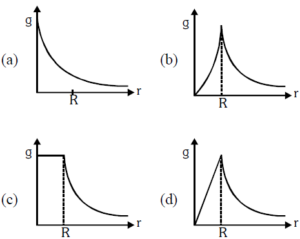
The additional kinetic energy to be provided to a satellite of mass m revolving around a planet of mass M, to transfer it from a circular orbit of radius R1 to another of radius R2(R2 > R1) is :
The additional kinetic energy required to transfer a satellite from a circular orbit of radius \( R_1 \) to \( R_2 \) is the difference in kinetic energy between the two orbits.
Kinetic energy in a circular orbit is:
\[
K = \frac{GMm}{2R}
\]
The kinetic energy difference is:
\[
\Delta K = \frac{GMm}{2R_1} - \frac{GMm}{2R_2}
\]
The dependence of acceleration due to gravity ‘g’ on the distance ‘r’ from the centre of the earth, assumed to be a sphere of radius R of uniform density, is as shown in figure below:-
A particle of mass M is situated at the centre of a spherical shell of same mass and radius a. The gravitational potential at a point situated at a/2 distance from the centre, will be :
Total gravitational potential at a point \( r = \frac{a}{2} \):
1. Potential due to the mass at the center:
The gravitational potential at a distance \( r \) from a point mass \( M \) is given by:
\[
V_{\text{center}} = -\frac{GM}{r}
\]
At \( r = \frac{a}{2} \), this becomes:
\[
V_{\text{center}} = -\frac{GM}{\frac{a}{2}} = -\frac{2GM}{a}
\]
2. **Potential due to the spherical shell**:
Inside a spherical shell, the gravitational potential is constant and equal to the potential at the surface, which is:
\[
V_{\text{shell}} = -\frac{GM}{a}
\]
### Total potential at \( r = \frac{a}{2} \):
The total gravitational potential is the sum of the potentials due to the mass at the center and the shell:
\[
V_{\text{total}} = V_{\text{center}} + V_{\text{shell}} = -\frac{2GM}{a} - \frac{GM}{a} = -\frac{3GM}{a}
\]
So, the gravitational potential at a distance \( \frac{a}{2} \) from the center is:
\[
V = -\frac{3GM}{a}
\]
Two identical spheres each of mass M and radius R are separated by a centre to centre distance 10R. The gravitational force on mass m placed at the midpoint of the line joining the centres of the spheres is :
At the midpoint, the gravitational forces exerted by the two identical spheres on the mass \( m \) have the same magnitude but act in opposite directions. Since these forces cancel each other out completely, the net gravitational force on the mass \( m \) is:
To find the dimensions of the gravitational constant \( G \), use Newton's law of gravitation:
\[
F = \frac{G M_1 M_2}{r^2}
\]
Where:
- \( F \) is force (with dimensions \( [M L T^{-2}] \)),
- \( M_1 \) and \( M_2 \) are masses (with dimensions \( [M] \)),
- \( r \) is distance (with dimensions \( [L] \)).
Rearranging for \( G \):
\[
G = \frac{F r^2}{M_1 M_2}
\]
Substitute the dimensions:
\[
G = \frac{[M L T^{-2}] [L^2]}{[M][M]}
\]
Simplify:
\[
G = [M^{-1} L^3 T^{-2}]
\]
Thus, the dimensions of \( G \) are \( [M^{-1} L^3 T^{-2}] \).
The escape velocity of a body on the earth surface is 11.2 km/s. If the same body is projected upward with velocity 22.4 km/s, the velocity of this body at infinite distance from the centre of the earth will be
Using conservation of energy: \(v_\infty = \sqrt{v^2 - v_e^2}\). Given \(v = 22.4\text{ km/s} = 2v_e\), we find \(v_\infty = \sqrt{(2v_e)^2 - v_e^2} = v_e\sqrt{3} = 11.2\sqrt{3}\text{ km/s}\).
If \(R\) is the radius of the earth and \(g\) is the acceleration due to gravity on the earth surface. Then the mean density of the earth will be
Acceleration due to gravity is \(g = \frac{GM}{R^2}\). Since mass \(M = \rho \times \frac{4}{3}\pi R^3\), we get \(g = \frac{G \left(\frac{4}{3}\pi R^3 \rho\right)}{R^2} = \frac{4}{3}\pi \rho GR\). Rearranging gives \(\rho = \frac{3g}{4\pi RG}\).
The ratio of the radius of the earth to that of the moon is 10. The ratio of acceleration due to gravity on the earth and on the moon is 6. The ratio of the escape velocity from the earth’s surface to that from the moon is:
Escape velocity is given by the formula \( v_e = \sqrt{2gR} \). The ratio of escape velocity of earth to moon is \( \frac{v_{earth}}{v_{moon}} = \sqrt{\frac{g_{earth}}{g_{moon}} \times \frac{R_{earth}}{R_{moon}}} = \sqrt{6 \times 10} = \sqrt{60} \approx 7.75 \approx 8 \).
Consider earth to be a homogeneous sphere. Scientist A goes deep down in a mine and scientist B goes high up in a balloon. The value of g measured by:
Acceleration due to gravity decreases with depth as \( g_d = g(1 - \frac{d}{R}) \) and with height as \( g_h = g(1 - \frac{2h}{R}) \). Since the formulas and rates of decrease are different, they decrease at different rates.