Two types of balances, the beam balance and the spring balance are commonly used for measuring weight at shops. If we are at the moon, we can continue to use :
On the Moon, the acceleration due to gravity is weaker (about \( \frac{1}{6} \) of that on Earth), affecting how a spring balance measures weight.
A spring balance relies on the gravitational force to measure weight based on the stretch of the spring, so it would give a lower reading on the Moon.
In contrast, a beam balance compares masses based on equilibrium, unaffected by gravity. Thus, it can be used without any change to measure weight accurately on the Moon.
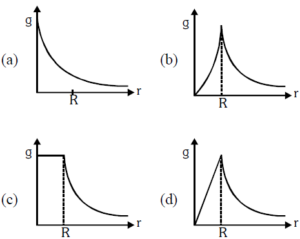
The dependence of acceleration due to gravity ‘g’ on the distance ‘r’ from the centre of the earth, assumed to be a sphere of radius R of uniform density, is as shown in figure below:-
A particle of mass M is situated at the centre of a spherical shell of same mass and radius a. The gravitational potential at a point situated at a/2 distance from the centre, will be :
Total gravitational potential at a point \( r = \frac{a}{2} \):
1. Potential due to the mass at the center:
The gravitational potential at a distance \( r \) from a point mass \( M \) is given by:
\[
V_{\text{center}} = -\frac{GM}{r}
\]
At \( r = \frac{a}{2} \), this becomes:
\[
V_{\text{center}} = -\frac{GM}{\frac{a}{2}} = -\frac{2GM}{a}
\]
2. **Potential due to the spherical shell**:
Inside a spherical shell, the gravitational potential is constant and equal to the potential at the surface, which is:
\[
V_{\text{shell}} = -\frac{GM}{a}
\]
### Total potential at \( r = \frac{a}{2} \):
The total gravitational potential is the sum of the potentials due to the mass at the center and the shell:
\[
V_{\text{total}} = V_{\text{center}} + V_{\text{shell}} = -\frac{2GM}{a} - \frac{GM}{a} = -\frac{3GM}{a}
\]
So, the gravitational potential at a distance \( \frac{a}{2} \) from the center is:
\[
V = -\frac{3GM}{a}
\]
The ratio of the radius of the earth to that of the moon is 10. The ratio of acceleration due to gravity on the earth and on the moon is 6. The ratio of the escape velocity from the earth’s surface to that from the moon is:
Escape velocity is given by the formula \( v_e = \sqrt{2gR} \). The ratio of escape velocity of earth to moon is \( \frac{v_{earth}}{v_{moon}} = \sqrt{\frac{g_{earth}}{g_{moon}} \times \frac{R_{earth}}{R_{moon}}} = \sqrt{6 \times 10} = \sqrt{60} \approx 7.75 \approx 8 \).
Two identical particles of combined mass \(M\), placed in space with certain separation, are released. Interaction between the particles is only of gravitational in nature and there is no external force present. Acceleration of one particle with respect to the other when separation between them is \(R\), has a magnitude :
Each particle has mass \(m = M/2\). The force is \(F = \frac{G m^2}{R^2} = \frac{GM^2}{4R^2}\). Acceleration of each is \(a = \frac{F}{m} = \frac{GM}{2R^2}\). Relative acceleration is \(a_{\text{rel}} = 2a = \frac{GM}{R^2}\).
Gravitational potential difference between a point on surface of planet and another point 10m above is 4J/kg. Considering gravitational field to be uniform, how much work is done in moving a mass of 2.0 kg from the surface to a point 5.0m above the surface?
Since the field is uniform, potential varies linearly with height. Potential difference at \(5.0\text{ m}\) is \(\Delta V = 4 \times \frac{5.0}{10} = 2\text{ J/kg}\. Work done is \(W = m \Delta V = 2.0 \times 2 = 4.0\text{ J}\).
Two concentric shells have mass \(M\) and \(m\) and their radii are \(R\) and \(r\) respectively, where \(R > r\). What is the gravitational potential at their common centre ?
The potential at the center of a shell of mass \(M\) and radius \(R\) is \(-\frac{GM}{R}\). By superposition, the total potential at the common center is \(V = -\frac{GM}{R} - \frac{Gm}{r} = -G\left[\frac{M}{R} + \frac{m}{r}\right]\).
The gravitational force between two particles with masses \(m\) and \(M\), initially at rest at great separation, pulls them together. When their separation becomes \(d\), then speed of either particle relative to the other will be :
Using energy conservation in the center-of-mass frame: \(\frac{1}{2} \mu v_{\text{rel}}^2 = \frac{GMm}{d}\), where \(\mu = \frac{Mm}{M+m}\) is the reduced mass. Substituting \(\mu\) yields \(v_{\text{rel}} = \sqrt{\frac{2G(M+m)}{d}}\).
What is the increase in gravitational potential energy of an object of mass m raised from the surface of earth to a height equal to n times of earth radius ?
The increase in potential energy is \(\Delta U = \frac{mgh}{1 + h/R}\). Since \(h = nR\), we get \(\Delta U = \frac{mg(nR)}{1 + n} = \left(\frac{n}{n+1}\right) mgR\).