Electric charges are distributed in a small volume. The flux of the electric field through a spherical surface of radius 10 cm surrounding the total charge is 25 V-m. The flux over a concentric sphere of radius 20 cm will be :
The electric flux through a spherical surface depends only on the total enclosed charge, as per Gauss's law:
\[
\Phi = \frac{Q_{\text{enc}}}{\epsilon_0}
\]
Since the total charge enclosed remains the same regardless of the sphere's radius, the flux through the concentric sphere of radius 20 cm will also be 25 V-m.
A square surface of side L metres is in the plane of the paper. A uniform electric field \(\overrightarrow{E} \)(volt/m), also in the plane of the paper, is limited only to the lower half of the square surface (see figure). The electric flux in SI units associated with the surface is :
Angle between area vector and Electric field is 90º. So Flux is zero.
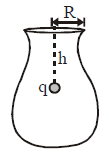
Consider the situation shown in figure. A point charge q is placed at a depth h= √3R exactly below the centre of mouth of a vessel whose open end is circular having a radius R. Calculate the electric flux through the lateral surface of this vessel.
To calculate the electric flux through the lateral surface of the vessel, we apply Gauss's law and consider the symmetry of the system.
---=====================================
Step-by-Step Solution:
1. Total Flux from the Charge \(q\):
The total flux emitted by the point charge \(q\) in all directions is:
\[
\Phi_{\text{total}} = \frac{q}{\varepsilon_0}.
\]
2. Flux Through the Circular Mouth:
Using the geometry of the vessel, the charge \(q\) is placed at a depth \(h = \sqrt{3}R\). The flux through the circular mouth of radius \(R\) can be calculated as:
\[
\Phi_{\text{mouth}} = \frac{q}{2\varepsilon_0}.
\]
3. Flux Through the Lateral Surface
By symmetry, the flux through the lateral surface is the remaining flux from the total flux after subtracting the flux through the mouth:
\[
\Phi_{\text{lateral}} = \Phi_{\text{total}} - \Phi_{\text{mouth}}.
\]
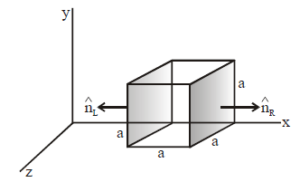
The electric field components in the given figure are \( E_{x}=\alpha x^{1/2}, E_{y}=E_{z}=0 \) in which \( \alpha=800NC^{-1}m^{-1/2}.\) The charge within the cube is if net flux through the cube is 1.05 N m²C–¹ (assume a = 0.1 m)
We are tasked with finding the charge enclosed within the cube using Gauss's Law:
Two parallel plates of infinite dimensions are uniformly charged. The surface charge density on one is \(\sigma_{A} \)and on the other is \(\sigma_{B}\), field intensity at point C will be
Net Electric Point at Point C will be directed downwards
A uniform electric field E = 2 × 10³ NC–¹ is acting along the positive x-axis. The flux of this field through a square of 10 cm on a side whose plane is parallel to the yz plane is :
To calculate the flux \(\Phi_E\) of the electric field \(\vec{E}\) through the square, we use the formula:
\[
\Phi_E = \vec{E} \cdot \vec{A}
\]
Here:
- \(\vec{E} = 2 \times 10^3 \, \text{N/C}\) (along the positive x-axis),
- \(\vec{A}\) is the area vector, perpendicular to the plane of the square.
Since the square lies in the yz-plane, its area vector points along the x-axis (same direction as \(\vec{E}\)), and its magnitude is the area of the square:
Two large thin metal plates are parallel and close to each other. On their inner faces, the plates have surface charge densities of opposite signs and magnitude 27\times 10^{-22}Cm^{-2}. The electric field \overrightarrow{E} in region II in between the plates is :
Electric field at Point II will be due to both the sheets so,
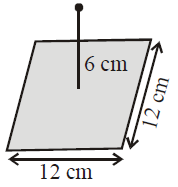
A point charge +20 μC is at a distance 6 cm directly above the centre of a square of side 12 cm as shown is figure. The magnitude of electric flux through the square is :
To calculate the electric flux through the square, we use Gauss's law and symmetry principles.
The total flux from a point charge \(q = +20 \, \mu\text{C}\) is:
An electric dipole of moment ‘p’ is placed in an electric field of intensity ‘E’. The dipole acquires a position such that the axis of the dipole makes an angle θ with the direction of the field. Assuming that the potential energy of the dipole to be zero when θ = 90°. the torque and the potential energy of the dipole will respectively be :
The torque acting on the dipole in an electric field is given by:
\[
\tau = pE \sin\theta
\]
The potential energy of the dipole is defined as:
\[
U = -pE \cos\theta
\]
Here, the potential energy is zero when \( \theta = 90^\circ \), which aligns with the condition provided.
\( \overrightarrow{p}=\left( 3\hat{i}+4\hat{j} \right) \) C-m, is kept in electric field \(\overrightarrow{E}=0.4kN/C\hat{i} \). What is the torque acting on it & the potential energy of the dipole ?