Electric Potential: Practice Problem & Solution
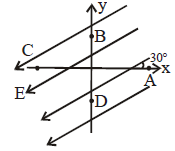
There exists a uniform electric field in the space as shown. Four points A, B, C and D are marked which are equidistant from the origin. If \(V_{A} , V_{B} , V_{C} and V_{D}\) are their potentials, respectively :
Short Solution (Best for NEET):
To solve this problem, we apply the core principles of Electric Potential. Understanding the underlying formula is key to arriving at the correct answer below:
In a uniform electric field, the electric potential decreases in the direction of the field. From the diagram:
1. Direction of the electric field: The field points downward and to the left (parallel to lines \(C \to D\)).
2. Potential relation:
- Points further along the direction of the field have lower potential.
- Points opposite to the field direction have higher potential.
3. Comparison of potentials:
- \(A\): Least aligned with the field direction (highest potential).
- \(B\): Slightly more aligned with the field direction than \(A\).
- \(D\): More aligned with the field direction than \(B\).
- \(C\): Most aligned with the field direction (lowest potential).
Thus, the potential order is:
\[
V_A > V_B > V_D > V_C
\]
Leave a Reply